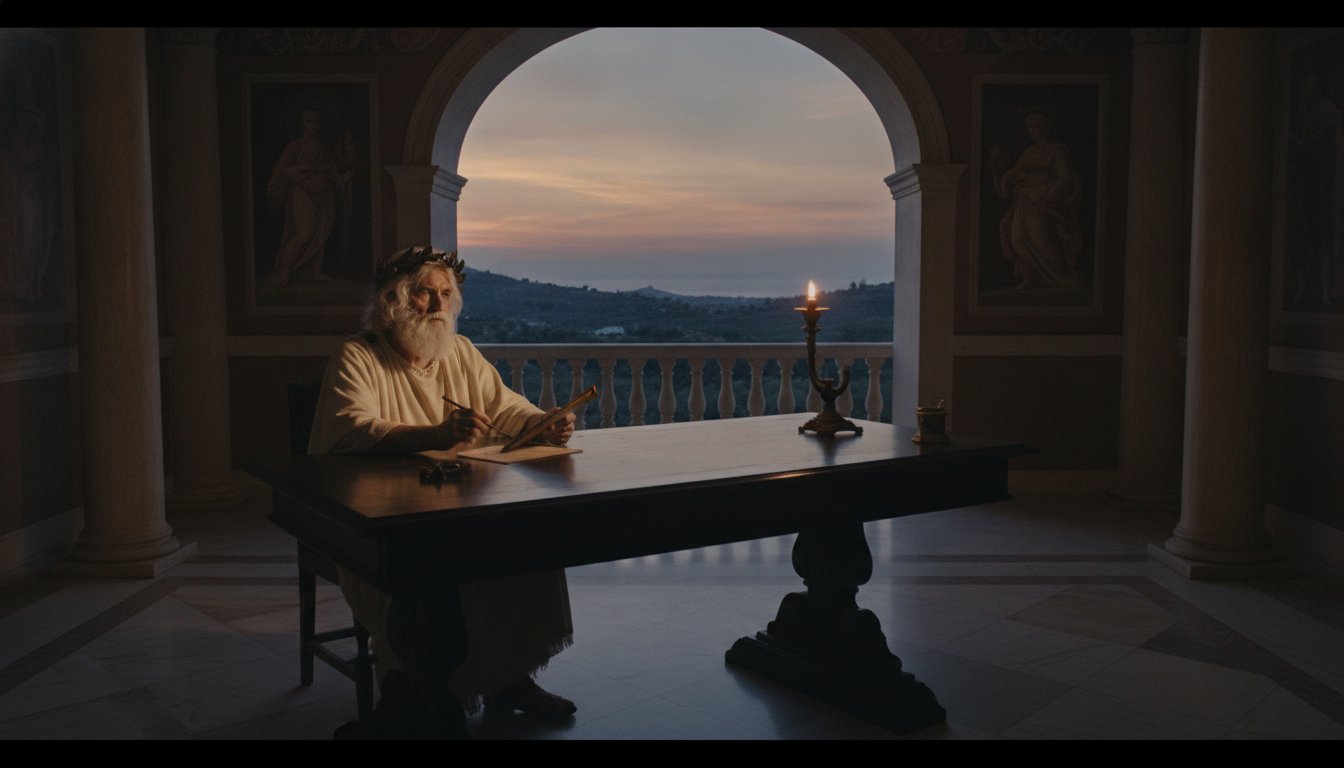
Most people drift into sleep carrying the weight of an unexamined day, unaware that they're repeating the same moral errors they made yesterday. This mental clutter isn't just a nuisance; it's a sign of a life lived on autopilot. For over 2,300 years, the Stoics understood that a day left unreviewed is a day lost to habit. You likely feel this stagnation in your own journey, a sense that your progress in virtue has stalled while the world demands more of your spirit. By integrating stoic evening reflection prompts into your nightly routine, you stop being a passive observer of your life and become its architect.
We invite you to rediscover the disciplined ritual of the nightly audit, a practice Seneca described as a judicial review of the soul. This isn't a casual exercise in memory but a serious pursuit of internal development. In the following sections, we'll explore how these ancient techniques clear the mind and provide a measurable path toward character refinement. You'll receive a curated template of prompts designed to help you confront your failures without shame and celebrate your small victories with intentionality. Let's step back into the quiet halls of history to learn how a simple evening review can build the mental fortitude you seek.
Key Takeaways
- Trace the lineage of the nightly review from Quintus Sextius to Seneca, discovering why the ancient mind was treated as a private courtroom.
- Master the use of stoic evening reflection prompts anchored in the four cardinal virtues to audit your daily actions with radical honesty.
- Learn the three essential questions that transform a simple memory exercise into a judicial audit for measurable moral progress.
- Design a "sacred space" for your evening ritual, creating a deliberate transition from the noise of the world to the silence of the self.
- See how the and "My Insights" function as a modern notebook to help you track recurring themes in your philosophical growth.
Table of Contents
- The Origins of the Nightly Review: From Sextius to Seneca
- The Architecture of Reflection: Three Essential Questions
- Categorized Stoic Evening Reflection Prompts for Modern Life
- Designing Your Evening Ritual: A Practical Template
- Refining the Soul with the
The Origins of the Nightly Review: From Sextius to Seneca
The sun sets, the house grows quiet, and the work of the soul begins. This isn't a modern invention of the wellness industry. It's a disciplined habit passed down through centuries of Stoic philosophy. While we often associate the nightly review with Seneca, he was actually a student of this method. He learned it from his mentor, Quintus Sextius. Sextius was a philosopher who combined Pythagorean rigor with Stoic ethics. Every night, before sleep, he would demand an account from his own soul. He didn't ask for a list of achievements. He asked for a list of improvements. He'd ask: "What ailment of your soul have you cured today? What vice have you resisted? In what part are you better?"
This lineage matters because it shows that Stoicism was never meant to be a dry academic theory. It was a practical toolkit for living. By the time Seneca began writing his letters, the nightly audit had become a foundational "shutdown sequence" for the philosophical life. It served as a way to maintain the Inner Citadel; that private mental space where we remain unshakeable by external chaos. The transition from a chaotic day to a state of Eudaimonia, or flourishing, required this bridge of self-examination. Without it, the lessons of the day are simply lost to the darkness of sleep.
Seneca’s Private Courtroom
In his work "On Anger" (De Ira), Seneca provides a vivid window into this ritual. He describes how, once the light was removed and his wife had fallen silent, he would examine his entire day. He went through his words and actions step by step. He treated his soul as a judge. "I hide nothing from myself," he wrote. "I pass over nothing." This wasn't about self-flagellation or wallowing in guilt. It was about radical honesty. By using specific stoic evening reflection prompts, he could identify exactly where his character had faltered. If he had spoken too sharply to a friend or allowed a minor frustration to ruin his peace, he noted it. He didn't hide the truth. He simply resolved to do better tomorrow. This practice helped define the Middle Stoic period's focus on practical, daily ethics.
Why the Ancient Ritual Remains Relevant
We live in a world that thrives on distraction. It's easy to fall into the "autopilot" life that Marcus Aurelius warned against; a life where we react to everything and reflect on nothing. The nightly review acts as a form of mental hygiene. It closes the open loops of daily stress. When you use stoic evening reflection prompts to audit your choices, you're not just thinking. You're building a repeatable evening ritual that fortifies your mind against future storms. It turns stagnation into measurable progress. You can even explore these techniques further through the Seneca AI, which brings these ancient dialogues into a modern context. By closing the day with intention, you ensure that tomorrow begins on a foundation of wisdom rather than a pile of unexamined mistakes.
The Architecture of Reflection: Three Essential Questions
The structure of a Stoic review isn't a loose collection of thoughts. It's an architectural framework. This disciplined practice requires you to review your actions against philosophical principles every night before sleep. It's a ritual of alignment. By using specific stoic evening reflection prompts, you move from the chaos of raw experience to the clarity of structured wisdom. The goal isn't to punish yourself for being human. The goal is objective observation. You are the witness and the judge of your own development.
Seneca and his contemporaries focused on three primary inquiries to anchor this audit. First, ask yourself: What bad habit did I cure today? This focuses on the pursuit of progress. It's not about being perfect. It's about being better than you were at dawn. Second: What temptation did I resist? This tests your temperance. It asks if you remained the master of your impulses. Finally: In what way am I better? This is the ultimate audit of character. It measures your adherence to eudaimonic virtue ethics, ensuring your life has a clear, moral direction.
Objectivity Over Emotion
To see clearly, you must distance yourself from your ego. The Stoics practiced "The View from Above." They viewed their actions as a third-party observer would. Try removing the "I" from your reflection. Instead of saying "I was angry," say "Anger was present." This allows you to see events as they truly are. It employs Phronesis, or practical wisdom, to evaluate your choices without the cloud of emotional bias. When you look at your day from this height, your mistakes become lessons rather than scars. Observation is the first step toward refinement.
The Forgiveness of the Self
A harsh judge is rarely a wise one. Seneca insisted on being a "lenient judge" to himself. He knew that human fallibility is a fact of nature. You must balance strict standards with a deep sense of self-compassion. The purpose of the review is to prepare the mind for "satisfied slumber." By acknowledging your errors and resolving to correct them, you release the day. You don't carry the weight of the past into your dreams. If you find yourself struggling to maintain this balance, joining a community in the Digital Agora can provide the shared wisdom needed to refine your practice. This ritual ensures that when you close your eyes, your soul is at peace. You've done the work. Now, you rest.
Categorized Stoic Evening Reflection Prompts for Modern Life
If the three questions discussed previously provide the foundation of your review, the Cardinal Virtues provide the walls and roof. To build a character that's truly unshakeable, your reflection must be anchored in Wisdom, Justice, Courage, and Temperance. These aren't abstract concepts. They're the practical tools the Stoics used to navigate the complexities of life in the Roman Empire. By categorizing your stoic evening reflection prompts around these virtues, you ensure that every aspect of your character receives the attention it requires for refinement.
Wisdom, or Phronesis, is the art of seeing things as they are. Ask yourself tonight: Did I mistake my opinion for a fact today? We often suffer more from our judgments than from events themselves. Justice, or Dikaiosyne, involves our duty to others. Reflect on this: How did I contribute to the common good or fail a neighbor? Stoicism teaches that we're part of a larger whole; a social bond that requires active maintenance. Courage, or Andreia, is the strength to do what's right despite fear or discomfort. Inquire: Did I choose the easy path over the right one? Finally, Temperance, or Sophrosyne, is the discipline of desire. Observe: Where did I allow my desires to outpace my needs? This audit prevents the "stagnation" of the soul and keeps your growth measurable.
Prompts for the Dichotomy of Control
Central to the teachings of Epictetus is the divide between what we control and what we don't. Your evening review is the perfect time to identify where you've misplaced your energy. Ask: Did I waste energy on things outside my influence today? Perhaps you worried about the weather, the economy, or another person's opinion. Now, contrast that with your internal state: How did I respond to an "indifferent" event with virtue? By identifying the "Internal vs. External" divide in your daily interactions, you reclaim your agency. You can track these patterns over time using My Insights to see where your peace is most frequently compromised.
Prompts for Social Cohesion
Marcus Aurelius frequently reminded himself that we were made for one another. His Meditations are filled with notes on how to deal with difficult people without losing his own virtue. Consider these inquiries: How did my actions affect the "Cosmopolis," the world community? Was I patient with those who were "ignorant of good and evil"? It's easy to be virtuous in isolation. The real test is how you navigate the friction of human relationships. Reflecting on your social interactions helps you view the mistakes of others with the same leniency Seneca suggested for yourself. This practice transforms every difficult encounter into a lesson in patience and Justice.
Designing Your Evening Ritual: A Practical Template
A ritual requires more than just intent; it requires a sanctuary. To effectively engage with stoic evening reflection prompts, you must first design the environment where your soul can speak without interruption. The Stoics often sought the quiet of the night to retreat into the "Inner Citadel." This transition from light to darkness is deeply symbolic. It marks the end of your duty to the external world and the beginning of your duty to yourself. Whether you prefer the tactile resistance of paper or the structured efficiency of a digital stoic journal, the medium should facilitate, not hinder, your deepest thoughts. Choose a tool that feels permanent and serious.
The Four-Step Ritual
To turn reflection into a repeatable discipline, follow this architectural sequence. It ensures your audit is thorough yet restorative. It's about building a rhythm that your mind recognizes and welcomes.
- Step 1: Disconnect. Silence the noise of the modern world. Put away your devices and allow the silence to settle. This is your "Digital Agora," a space reserved for clarity.
- Step 2: Review. Walk through your day’s events chronologically. Start from the moment you woke. Observe your interactions, your internal reactions, and your choices as if watching a play.
- Step 3: Forgive. As discussed earlier, don't linger in guilt. Acknowledge your errors with the objective eye of a mentor. Resolve to adjust your course tomorrow.
- Step 4: Prepare. Briefly visualize the challenges of the coming day. This small act of premeditatio malorum ensures you aren't caught off guard by the rising sun.
Overcoming Resistance
Consistency is the hallmark of the Stoic. On nights when you feel exhausted, don't abandon the ritual. Employ the 2-minute rule. Answer just one of your stoic evening reflection prompts. Even a single sentence of honest observation is better than a night of unexamined sleep. On days where it feels like nothing happened, look closer. Seek the subtle virtues. Did you maintain your composure during a dull meeting? Did you choose a healthy meal over a convenient one? These small victories are the stones that build a great character. If you find your discipline wavering, you can find strength and shared accountability within the community of practitioners who prioritize this nightly audit. Every night is an opportunity to reset the clock of your character.
Refining the Soul with the
Marcus Aurelius wrote for himself. His Meditations were a private courtroom where he held his own spirit accountable for its deviations from the path of virtue. We do the same. The acts as a modern mentor for your nightly review, transforming the ancient practice of journaling into a dynamic process of growth. It doesn't just store your words; it analyzes them. When you use stoic evening reflection prompts within this ecosystem, you aren't just recording history. You're building a data-driven map of your soul. The Marcus Aurelius AI can then challenge your specific assumptions, forcing you to look deeper into the motives behind your choices. This is where the transition from daily reflection to a lifetime of wisdom begins.
One of the greatest challenges in self-improvement is seeing our own blind spots. We often repeat the same moral errors because we fail to see the patterns. Through My Insights, the platform identifies recurring themes in your character development. You might notice that your struggle with Temperance always occurs during high-stress work weeks, or that your Courage is most tested when you face social pressure. These patterns are often invisible in the heat of the moment. AI brings them into the light. By reviewing these insights, you can adjust your morning preparations to better meet the specific challenges of your life. It turns the evening audit into a strategic advantage.
The Evolution of the Stoic Notebook
The transition from papyrus to pixels isn't a loss of tradition. It's an expansion. Ancient Stoics carried physical notebooks, or hypomnemata, to record their failures and triumphs. By using a digital platform, you create a searchable "Bibliotheca Stoica" of your own life. The AI Stoic Coach acts as a bridge, offering immediate philosophical feedback that helps you interpret your actions through the lens of primary sources. It's like having a private conversation with the masters. This consistent practice builds a library of growth that you can reference years from now, seeing exactly how far you've traveled on the path to virtue.
Continue Your Journey
The evening review is but one step in a 2,300-year-old journey of the soul. Explore the Virtue Guide to deepen your practice and transform your nightly reflections into lasting character.
Building the Inner Citadel Nightly
The sun has set on the ancient world, but the discipline of the soul remains unchanged. You've explored how the lineage of Sextius and Seneca provides a foundation for the nightly audit. By categorizing your stoic evening reflection prompts around Wisdom, Justice, Courage, and Temperance, you transform a simple habit into a judicial review of your progress. This ritual doesn't just clear the mind for sleep; it prepares the spirit for the dawn. It's the difference between drifting through life and steering your own ship with intention.
Modern technology now serves as the latest chapter in this 2,300 year old story. Thousands of modern Stoics use the to track their growth with precision. This digital companion is trained on primary sources like the Meditations and Enchiridion. It offers personalized insights through AI that reveal the hidden patterns in your choices. You don't have to walk this path alone. Begin your disciplined reflection with the Virtue Guide today. Every entry you make is a stone placed in the foundation of a more resilient, virtuous self. Your journey toward character refinement is a life's work. It begins tonight.
Frequently Asked Questions
What is the best time for Stoic evening reflection?
The optimal time is the threshold between the day’s labor and the night’s rest. Seneca preferred the deep quiet after his household had settled and his wife had fallen silent. This deliberate transition allows you to review your actions without the immediate pressure of the next task, ensuring your audit is conducted with a clear and focused mind.
Should I write my reflections down or just think about them?
Writing is significantly more effective than mere thought because it forces a structure upon your internal dialogue. The act of recording your thoughts creates a distance between you and your emotions, allowing you to see your life as an objective observer. Using the as a digital companion allows you to archive these moments for future study and character refinement.
What if I had a terrible day and don’t want to reflect?
A difficult day is exactly when you should not skip your stoic evening reflection prompts. These are the moments when your character is tested most, and avoiding the review only allows moral errors to take root. If you feel overwhelmed, apply the 2-minute rule to record just one honest observation. This maintains the discipline and prevents the ego from hiding from its own mistakes.
How long should a Stoic evening review take?
A productive review should take between five and fifteen minutes. It isn't an exhaustive autobiography of the day’s events. It's a focused audit of specific virtues and impulses. The goal is to be concise and honest rather than expansive, ensuring the ritual remains a repeatable part of your nightly routine.
Can I combine morning and evening Stoic practices?
Morning and evening practices are two halves of a single circle and should be practiced together. The morning is for preparation, where you visualize the challenges ahead and set your intentions. The evening is for the review, where you audit your actual performance against those morning preparations to see where you stood firm and where you faltered.
Is Stoic reflection the same as modern "gratitude journaling"?
Stoic reflection differs from gratitude journaling by focusing primarily on moral accountability and character audit. While gratitude focuses on external blessings, Stoic prompts focus on your internal responses and choices. It's a judicial review of your character rather than a list of pleasant events, though acknowledging what went well is part of the process.
What did Marcus Aurelius write about in his evening journals?
Marcus Aurelius used his journals to remind himself of the Dichotomy of Control and his duty to the common good. He often wrote about dealing with difficult people without losing his own temperance. His Meditations show him practicing stoic evening reflection prompts to correct his impulses and remain grounded in philosophical principles despite the pressures of leadership.
How do I know if I am making progress in my Stoic practice?
Progress is visible in your immediate reactions to external events. You'll notice that situations which once sparked anger or anxiety now meet with a calm and reasoned response. You can track this evolution through "My Insights" to see the tangible shifts in your character and identify the recurring themes of your growth over weeks and months.
Ed Korporaal
Founder, StoicOs.ai