Sunlit panorama of ancient Athens — marble colonnade, citizens in the agora, the Acropolis crowning the city in golden hour light.

Stoic Os · The Agora

Enter the Stoa

Before you learn the Stoa, you must feel it.

Before you learn the Stoa, you must feel it. Walk slowly. There is no curriculum here. There is only a long room of light, and a question that has been waiting for you since Athens: how should I live?

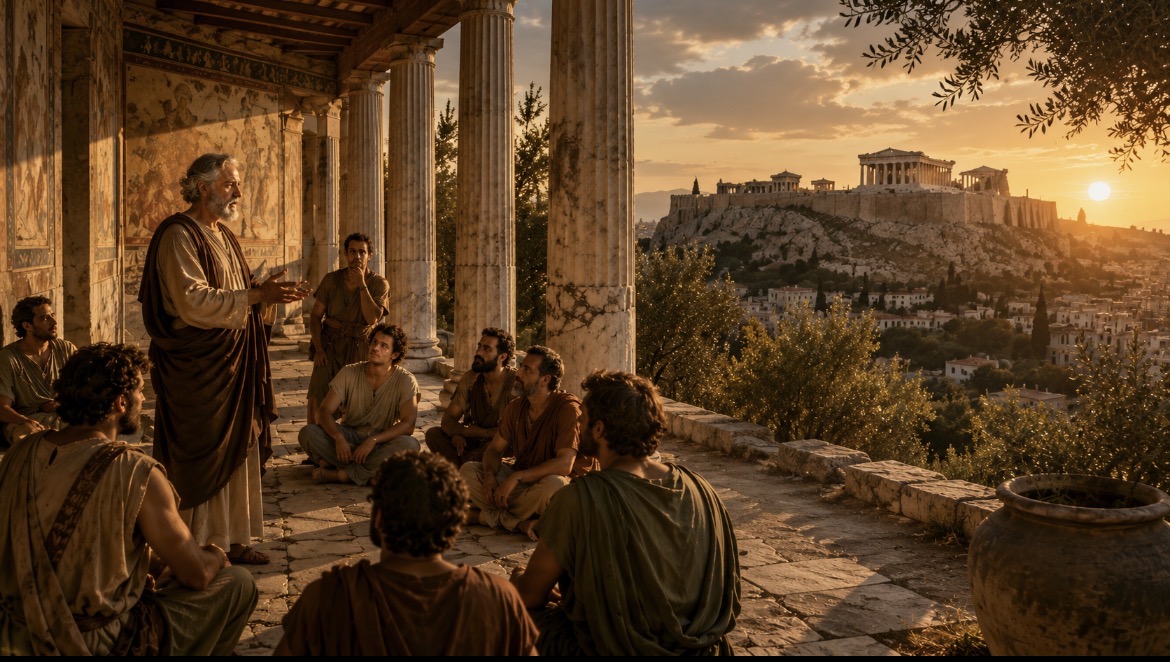
Zeno of Citium teaching seated students on marble flagstones under a colonnade. The Acropolis rises at sunset, framed by olive branches.

II · 334 – 206 BC

The Greek Dawn

Morning light over Athens. Olive trees. Marble columns. The beginning of the Stoa.

Zeno of Citium · Cleanthes · Chrysippus

A shipwrecked merchant walks into a bookshop in Athens and never leaves. The school he founds is named after the painted porch where he teaches in the open air — the stoa poikilē. Anyone may listen. The first philosophy of the everyday is born under a roof of olive light.

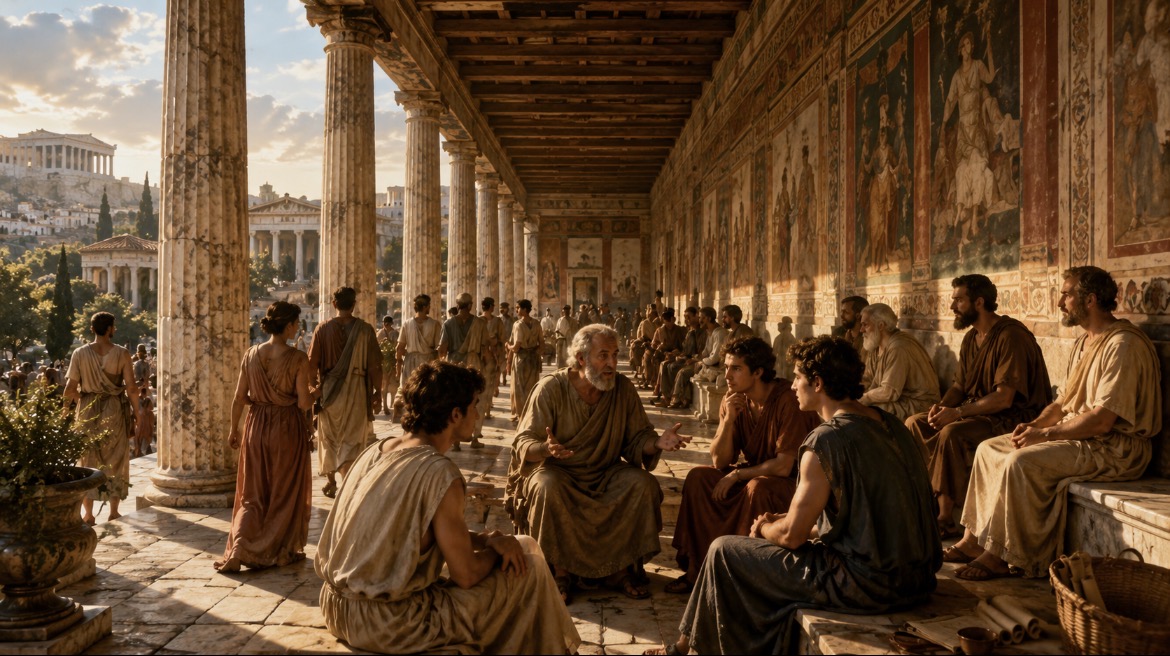
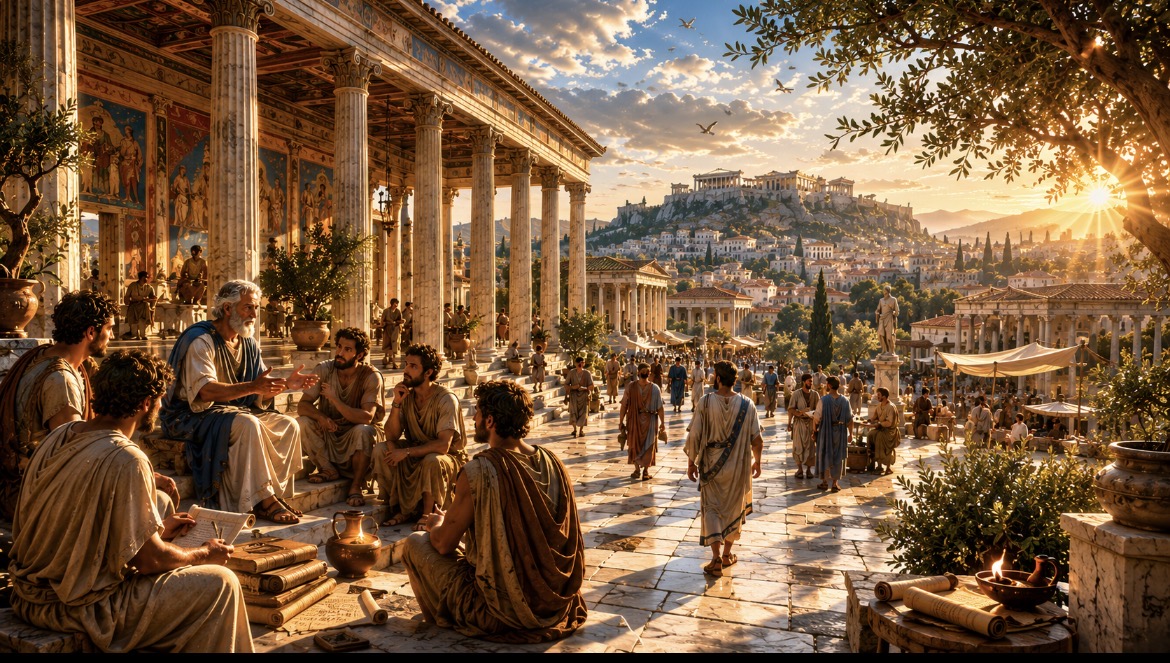
The painted porch of ancient Athens at golden hour. Citizens, students, travellers and an elder philosopher in animated dialogue beneath frescoed walls and marble columns; the Acropolis visible beyond.

III · The School of Reason

The Stoa Poikile

Beneath the painted porch. Frescoes warm with afternoon light. Voices, then quieter voices, then a question.

No sacred mysteries.

No hidden doctrines.

Only observation.

Only dialogue.

Only reason.

Beneath the painted porch of Athens, people gathered not to worship, but to think. Merchants sat beside students. Citizens debated with travellers. Questions were welcomed. Arguments were tested. Ideas were challenged.

The Stoa was not built upon revelation or authority. It was built upon reason.

Here, wisdom was not handed down. It was discovered together.

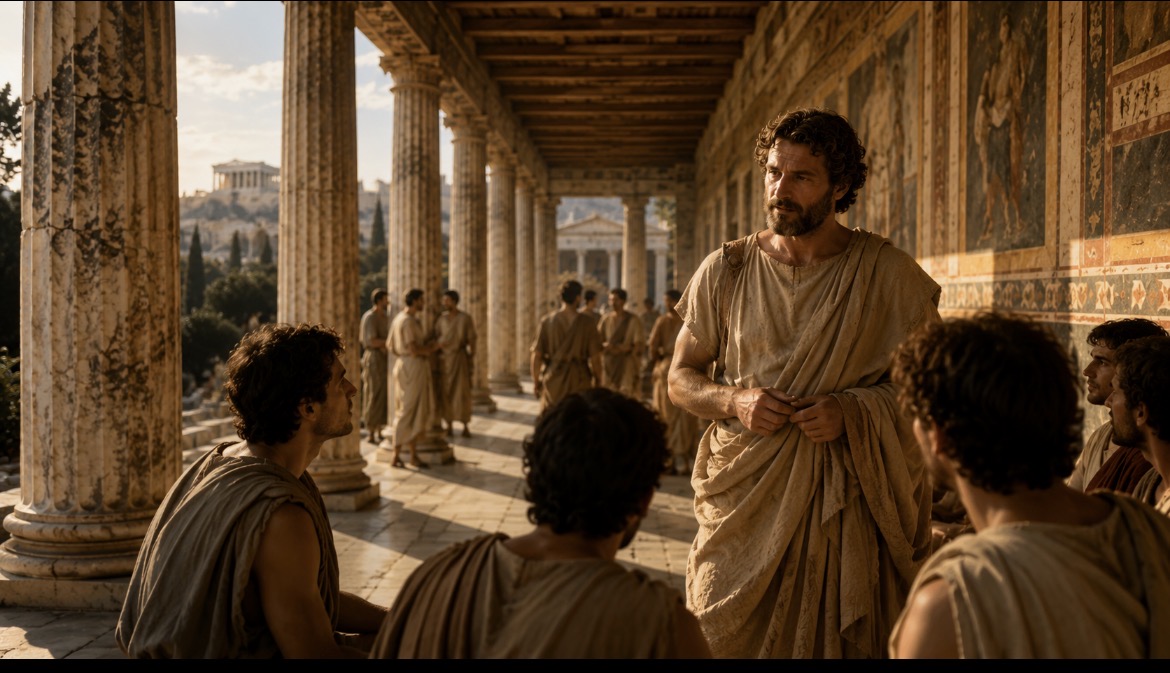
Cleanthes addressing his disciples beneath the colonnade of the Stoa. Earth-tone toga, marble columns, frescoed wall, the Acropolis visible through the columns in golden afternoon light.

IV · 331 – 232 BC

Cleanthes

Discipline and Devotion

Where Zeno opened the door,

Cleanthes remained when others left.

Discipline · Endurance · Humility · Devotion

After Zeno came the test of endurance.

Cleanthes was not born into wealth. He worked by night carrying water through the streets of Athens and studied philosophy by day.

Others admired wisdom. Cleanthes practiced it. He believed that character was built through discipline, effort and loyalty to what is right.

Under his guidance the Stoa became more than an idea. It became a way of life.

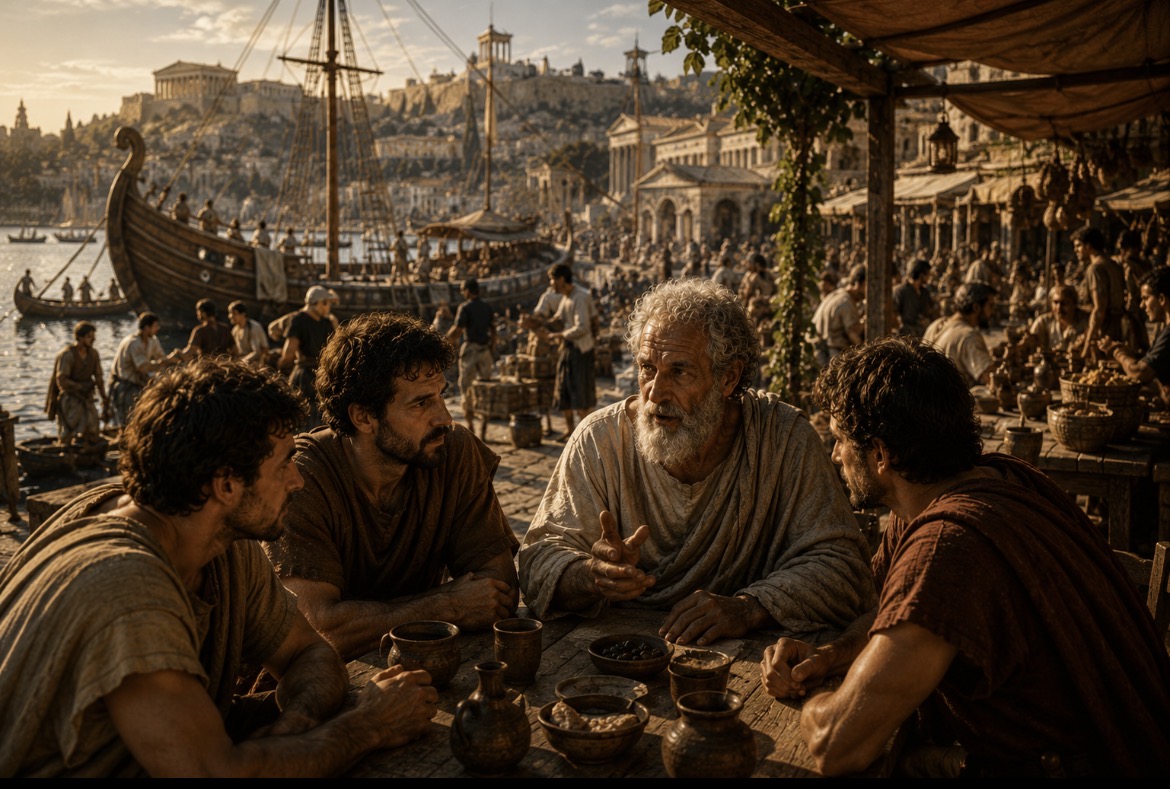
An elder philosopher in pale toga gestures mid-argument at a wooden table by the harbor. Three companions lean in to listen. Behind them: docked ships, a teeming marketplace, and the Acropolis crowning the city in golden hour light.

V · 279 – 206 BC

Chrysippus

The System of Reason

To live well,

one must first learn to think clearly.

Impression · Reasoning · Assent · Judgment · Action

Athens was full of opinions. The harbor was full of merchants, sailors, politicians and philosophers. Everyone had a view. Not every view was true.

Chrysippus believed wisdom begins when impressions are examined instead of blindly accepted. At crowded tables and beneath the noise of the city, arguments were tested. Questions were challenged. Assumptions were exposed.

Reason became a tool for freedom. What matters is not what appears to be true. What matters is what survives examination.

Through Chrysippus, Stoicism gained its structure. Through reason, philosophy became practical.

Chrysippus of Soli · Third head of the Stoic school · Often called “The Second Founder of Stoicism”

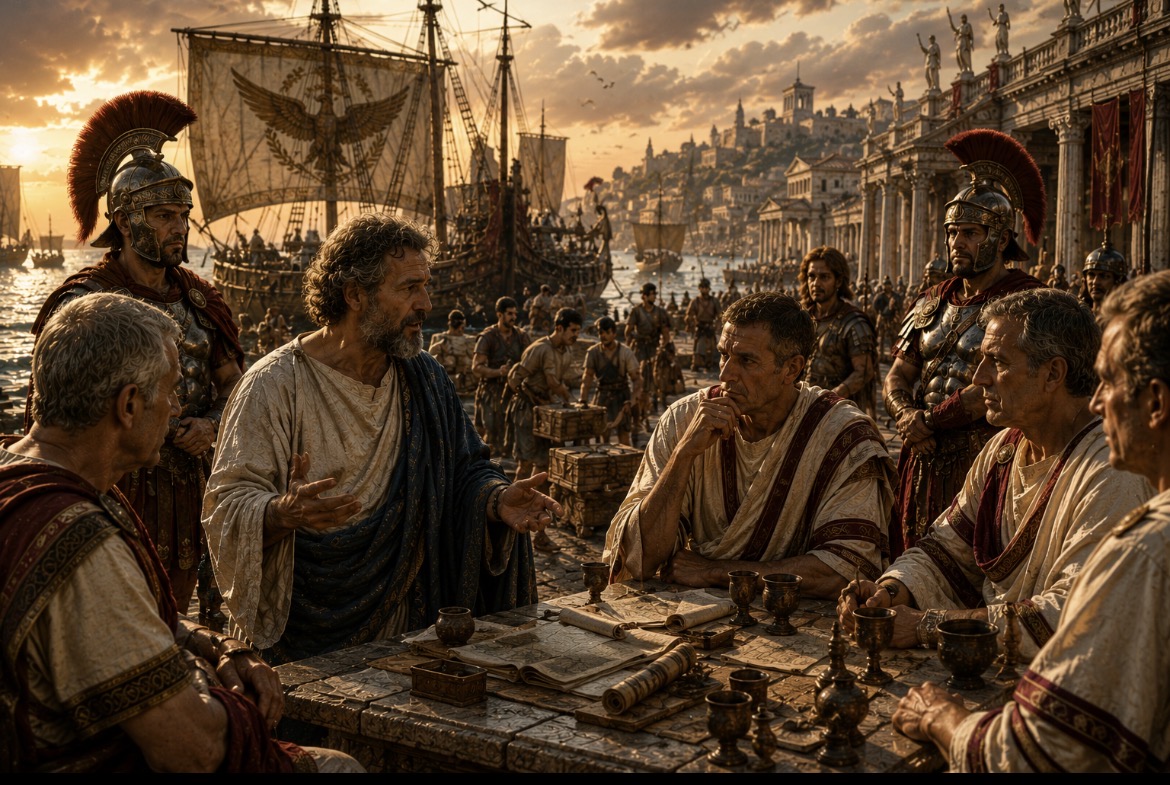
A Greek philosopher in pale toga addresses a circle of Roman senators and a centurion at a stone table by the harbor at sunset. Roman warships fly an eagle banner; columns and statues line the quay; the city of Rome rises beyond.

VI · c. 185 – 110 BC

The Bridge to Rome

When Greek Wisdom Met Roman Power

Rome conquered Greece with legions.

Greece conquered Rome with ideas.

Wisdom · Character · Duty · Culture · Civilization

The Mediterranean now belonged to Rome. Its legions guarded the ports. Its senators governed an expanding republic. Its banners flew across the known world. Power had chosen its capital.

Yet in this age of conquest, something unexpected happened. The conquerors became students. Roman statesmen looked beyond wealth, beyond military victory and beyond politics. They looked toward Greece — not for land, not for gold, but for wisdom.

Panaetius of Rhodes stood between two civilizations. Behind him lay Athens. Before him stood Rome. He carried no army. No fleet. No authority. Only ideas — about character, about duty, about reason, about virtue.

Through Panaetius, Stoicism crossed the sea. The philosophy born beneath the painted porch of Athens began its journey into the heart of Rome. Under the watchful eyes of soldiers and senators, a different kind of power emerged — the power of an examined life. The sword had conquered territories. Ideas would conquer centuries.

Panaetius of Rhodes · c. 185 – 110 BC · Stoic philosopher · Teacher and advisor to influential Roman statesmen · Widely regarded as the philosopher who introduced Stoicism to the Roman elite

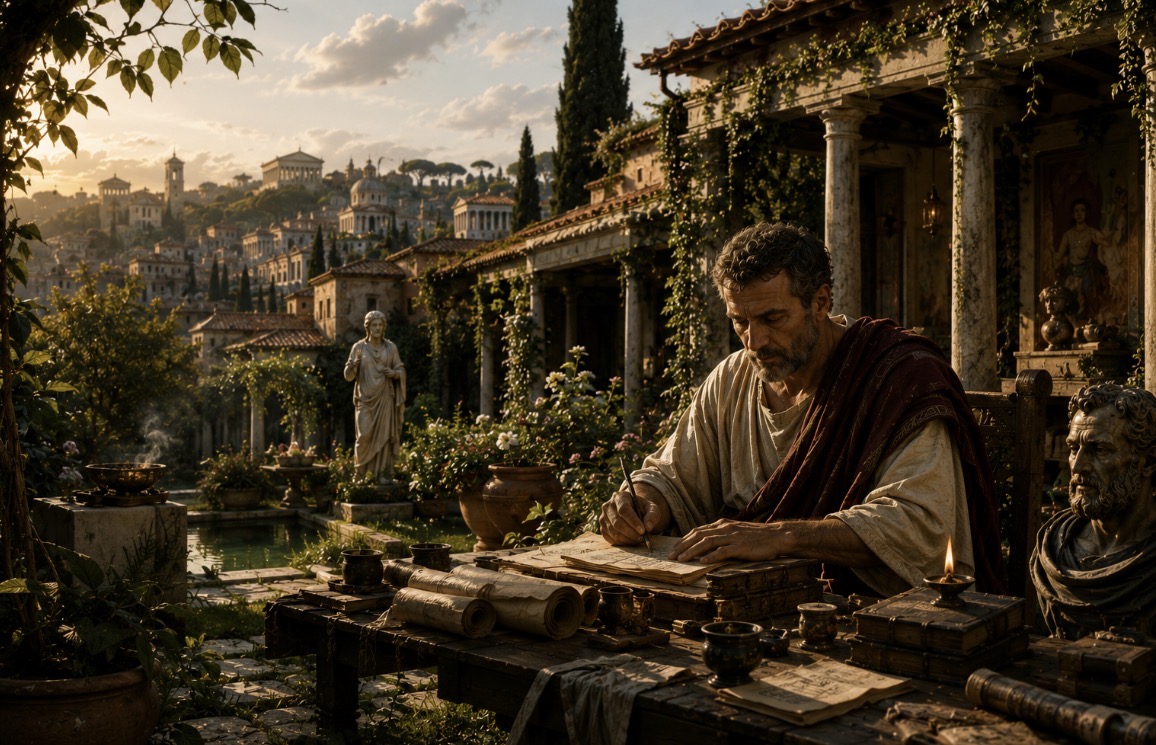
Seneca writing at a stone table in his villa garden at sunset. Cypress trees, ivy-clad colonnade, marble statues, a reflecting pool, and the city of Rome rising in the distance under golden hour light.

VII · 4 BC – AD 65

Seneca

Wisdom Amid Power

It is not the man who has too little,

but the man who craves more,

who is poor.

— Seneca

Virtue · Fortune · Character · Mortality · Inner Freedom

Rome was now the center of the world. Its roads crossed continents. Its armies guarded an empire. Its rulers commanded immense power. Yet beneath the marble grandeur of Rome, another struggle unfolded — the struggle within.

Seneca lived close to power. Closer than most philosophers ever dared. He advised emperors. He accumulated wealth. He moved through palaces and courts. Yet his writings returned again and again to the same question: how can a person remain free?

In his Letters to Lucilius, Seneca spoke not as a distant teacher but as a companion. He wrote about fear. About anger. About fortune. About death. About the daily practice of philosophy. His wisdom was not meant for schools. It was meant for life.

As Nero's reign darkened, Seneca gradually withdrew from public life. After the Pisonian conspiracy of AD 65, he was accused of involvement. Whether guilty or innocent remains uncertain. Nero ordered him to end his own life. Seneca obeyed with composure. The philosopher who had written so often about mortality now faced it himself.

His final lesson was not written. It was lived.

Lucius Annaeus Seneca · 4 BC – AD 65 · Roman Stoic philosopher · Statesman · Author of the Letters to Lucilius · Advisor to Emperor Nero · One of the most influential voices in Stoicism

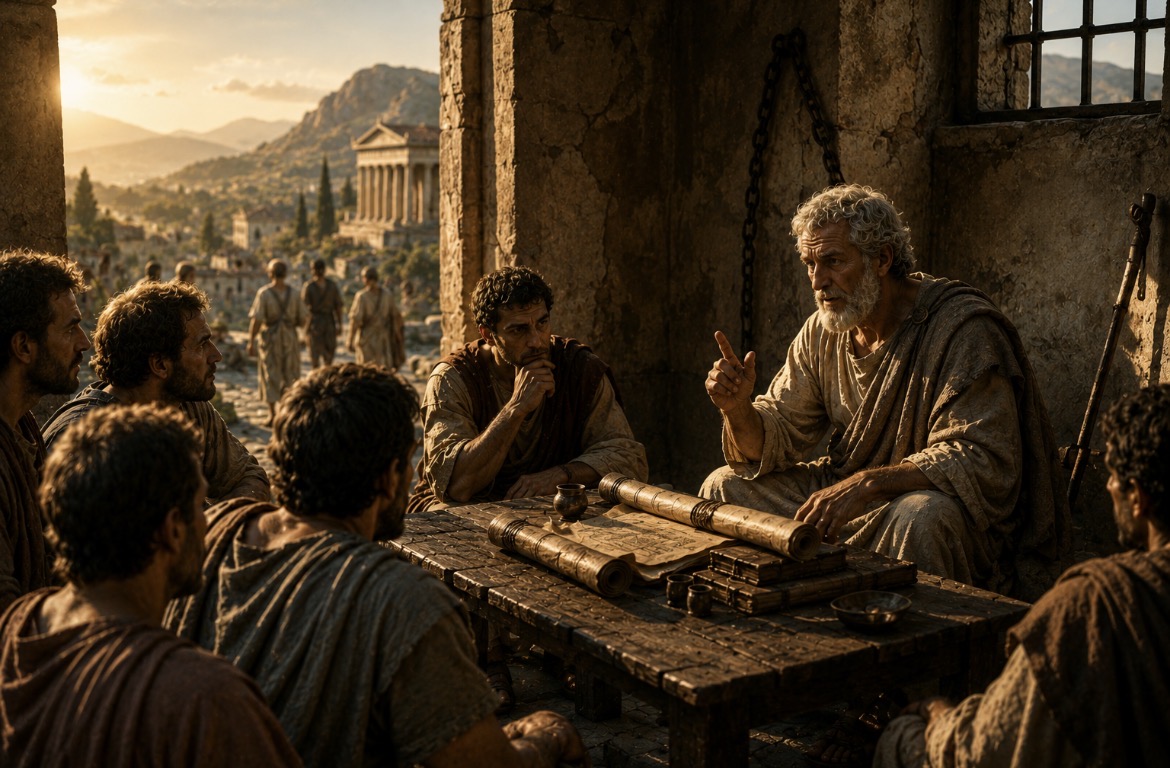
Epictetus, weathered and grey-bearded, sits before a low wooden table piled with scrolls and small wooden tablets, raising one finger as he teaches. His students lean in around him in earth-tone togas. Iron chains hang from the cracked wall behind him; through the open arch, the temple of an ancient mountain town glows in golden hour light.

VIII · c. AD 50 – 135

Epictetus

The Freedom Within

No man is free who is not master of himself.

— Epictetus

Freedom · Self-Mastery · Discipline · Acceptance · Character

Epictetus was born a slave. He owned nothing. His future belonged to others. His body could be commanded. His movements controlled. His life directed by another man's will. Yet even as a slave, he discovered something no master could take away — the freedom of the mind.

After gaining his freedom, Epictetus became a teacher. Not in palaces. Not in the Senate. Not among the wealthy. But among ordinary people seeking a better way to live.

His message was simple. Some things are within our control. Some things are not. Confusion begins when we mistake one for the other. Peace begins when we learn the difference.

Students traveled long distances to hear him speak. They did not come for theories. They came for clarity. For courage. For practical wisdom. For a way to remain steady in an uncertain world.

Epictetus taught that freedom does not come from wealth. Nor from status. Nor from power. It comes from governing oneself. The person who masters his judgments becomes unconquerable.

His student Arrian recorded his teachings. Through those writings, the voice of a former slave would echo through centuries — eventually reaching an emperor named Marcus Aurelius.

Epictetus · c. AD 50 – 135 · Born a slave · Later one of the most influential Stoic teachers in history · His teachings survive through the Discourses and the Enchiridion recorded by Arrian

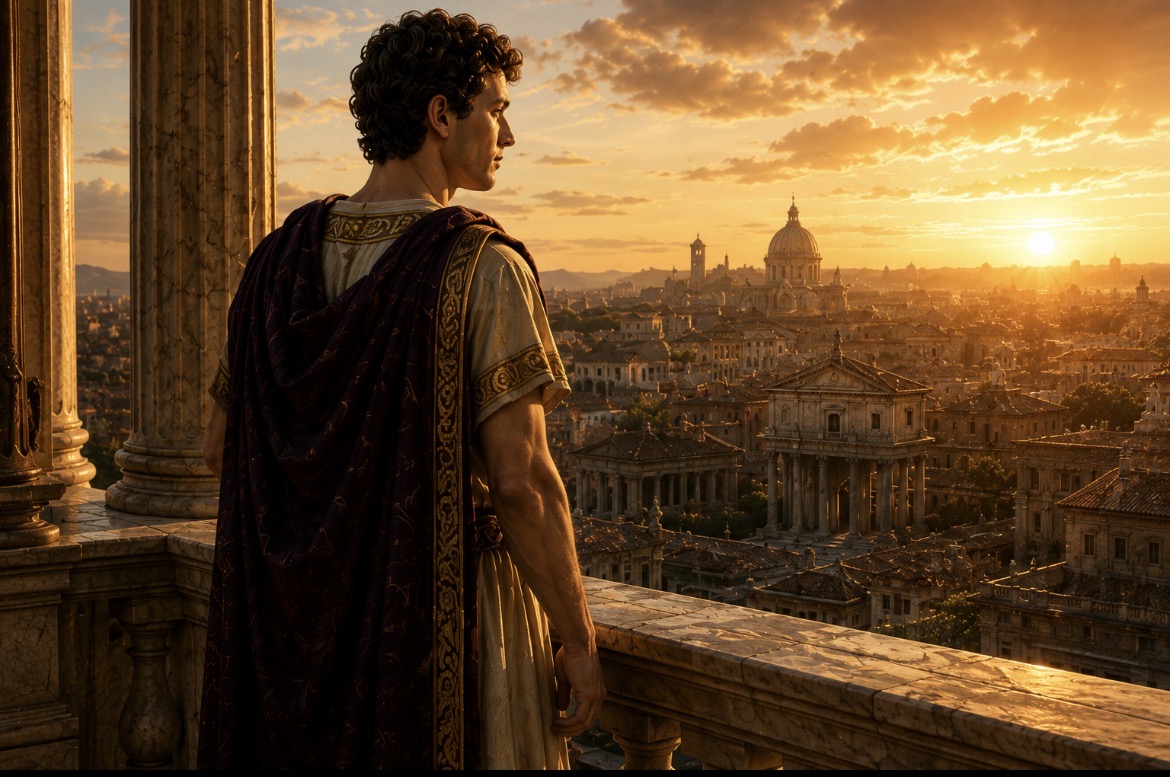
A young Marcus Aurelius, dark curly hair, in cream tunic and deep purple cloak embroidered with gold, stands at a marble balcony overlooking the city of Rome at sunset. Domes, columns and rooftops stretch to the horizon under a vast golden sky.

IX · AD 121 – 180

Marcus Aurelius

The Philosopher

Waste no more time arguing what a good man should be.

Be one.

— Marcus Aurelius

Character · Duty · Humility · Philosophy · Service

Marcus Aurelius was born in AD 121 as Marcus Annius Verus. From an early age, those around him noticed something unusual. A seriousness. A sincerity. A quiet devotion to duty.

The Emperor Hadrian saw these qualities as well. He reportedly gave the boy a nickname: Verissimus — “The Most Truthful,” “The Most Upright.” Not because of ambition. Not because of status. But because of character.

The future of Marcus changed when Hadrian adopted Antoninus Pius and required him to adopt two young heirs: Marcus Aurelius and Lucius Verus. The path toward the throne was chosen for him. Yet Marcus never viewed the imperial office as a reward. He viewed it as a responsibility.

As a young man he immersed himself in philosophy. Among all his teachers, one stood above the rest — Junius Rusticus. Marcus would later thank Rusticus in his Meditations for introducing him to the teachings of Epictetus, and for showing him the value of simplicity, humility and self-examination.

Other teachers followed. Apollonius of Chalcedon. Sextus of Chaeronea. Fronto, the great rhetorician. Each shaped his mind. But it was Stoicism that shaped his character.

Standing above Rome, Marcus looked upon the greatest city in the world. Yet his attention was drawn elsewhere. Not to power. Not to glory. Not to wealth. But to a question that would guide his entire life: how should a human being live?

Marcus Aurelius · AD 121 – 180 · Roman Emperor · Student of Stoicism · Adopted heir of Antoninus Pius · Author of the Meditations · Widely regarded as one of the wisest rulers in history

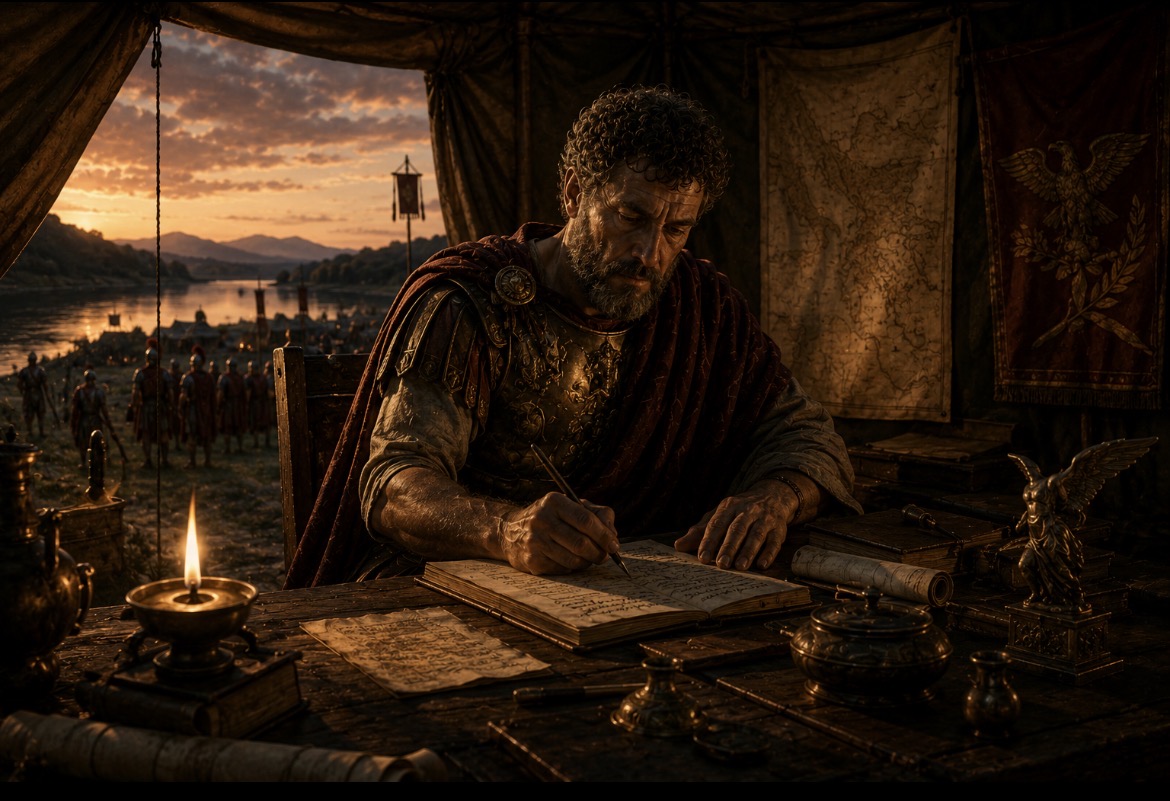
Marcus Aurelius, in bronze armour and crimson cloak, writes by lamplight inside his command tent on the Danube frontier at dusk. Beyond the open tent flap, Roman legions stand in formation along the river under a burning orange sky; maps and standards hang on the tent wall behind him.

X · AD 161 – 180 · The Marcomannic Wars

Marcus Aurelius

The Philosopher in War

The impediment to action advances action.

What stands in the way becomes the way.

— Marcus Aurelius

War · Reflection · Reason · Discipline · Virtue

The empire was at war. Along the Danube frontier, Roman legions faced relentless pressure from tribes beyond the river. Winter was harsh. Supplies were uncertain. Thousands depended on the decisions of one man. That man was Marcus Aurelius.

By day he commanded armies. By night he commanded himself. In the quiet of his command tent, illuminated only by oil lamps and the glow of distant campfires, Marcus wrote private reflections. Not for publication. Not for history. Not for fame. Only for himself.

These notes would become known as the Meditations. One of the most remarkable books ever written. Not because it teaches how to rule an empire — but because it teaches how to rule oneself.

Outside stood the armies of Rome. Inside sat a man trying to remain good.

The greatest battle of Marcus Aurelius was not fought against the Marcomanni. It was fought within.

Marcus Aurelius · AD 121 – 180 · Roman Emperor · Stoic philosopher · Commander of the Roman legions on the Danube frontier · Author of the Meditations · Widely regarded as one of the wisest rulers in history.

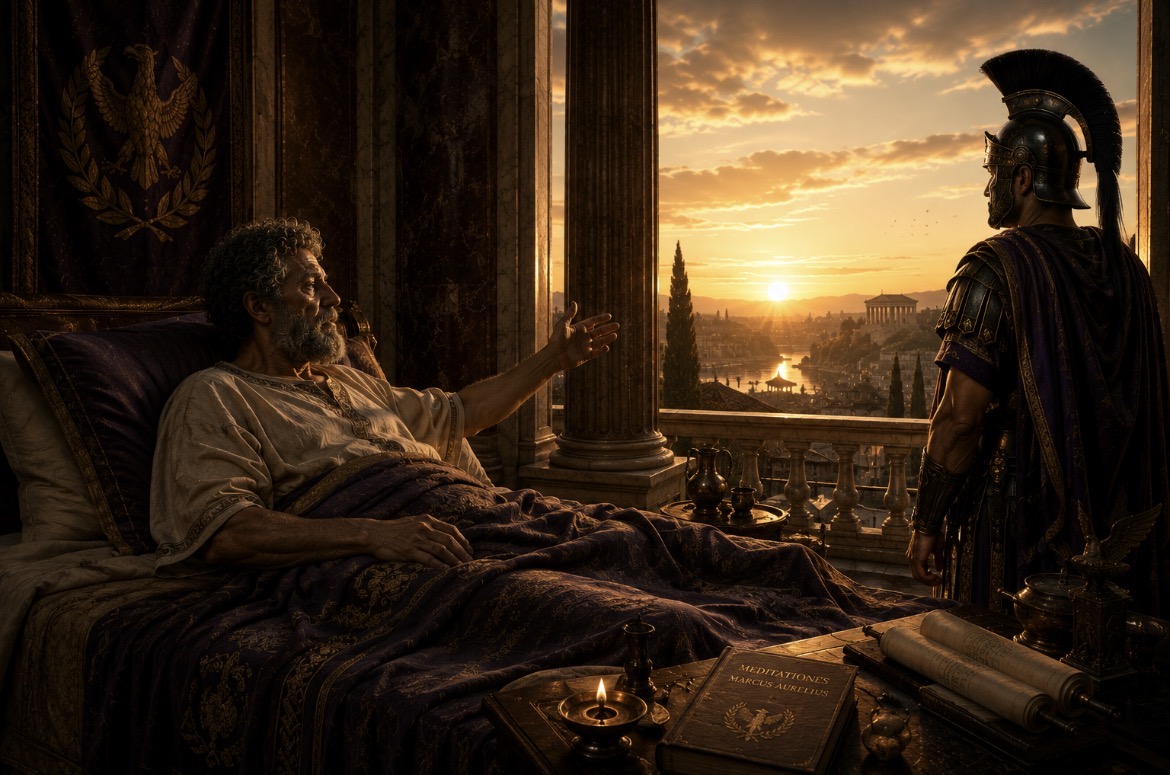
An elder Marcus Aurelius reclines on a silk-draped imperial couch in a marble chamber at sunset. He gestures with an open hand toward a Praetorian guard standing by the open balcony. Beyond the columns, Rome stretches to the horizon under a vast golden sky; on a low table rest a lit oil lamp and a leather codex inscribed ‘Meditationes — Marcus Aurelius’.

XI · AD 180 · The Last Day

Marcus Aurelius

The Last Sunset

Do not act as if you were going to live ten thousand years.

Death hangs over you.

While you live, while it is in your power, be good.

— Marcus Aurelius

Amor Fati · Acceptance · Nature · Logos · Mortality

The wars were ending. The campaigns were nearly complete. The burdens of empire had been carried for many years. Marcus Aurelius had spent a lifetime serving something greater than himself. Now another duty awaited him.

Age had weakened his body. Loss had visited him often. He had endured plague, famine, war, political intrigue, and the deaths of many of those he loved. Yet through it all he returned to the same principles. Reason. Duty. Virtue. Acceptance.

As dawn approached, Marcus rested in his chamber. Beyond the balcony the first light touched the horizon. The empire was waking. A new day was beginning.

According to later tradition, Marcus called for a Praetorian guard. The young soldier entered. Marcus looked toward the rising sun, then toward the man whose life still stretched before him. And he spoke words that have echoed through the centuries.

“Go now. For you, the sun is rising. For me, it is setting.”

There was no bitterness. No fear. No resistance. Only acceptance — the acceptance of a man who understood that everything borrowed from Nature must one day be returned.

For Marcus, death was not an enemy. It was part of the same order that had given him life. The same Logos. The same universe. The same eternal process of becoming and passing away.

The philosopher who had spent a lifetime preparing for this moment now met it calmly. As he had lived, so he departed.

The sun rises. The sun sets. The Logos remains.

Marcus Aurelius · AD 121 – 180 · Roman Emperor · Stoic philosopher · Author of the Meditations. He died during the Danubian campaigns in AD 180. The final words presented here belong to later historical tradition and reflect the Stoic spirit for which Marcus Aurelius became known.
XII

The Library

A long classical hall. Bookshelves to the vaulted ceiling. Reading tables of dark wood. Quiet.

A future home for texts, courses, exercises, reflections, and the books that shaped the practice. For now, the shelves are being filled.

  • Texts
  • Courses
  • Exercises
  • Reflections
  • Book Recommendations

Coming soon. The place is being built. The wisdom will follow.

XIII

The Hall of Light

An open room. White stone. High windows. Long shafts of golden afternoon light cutting across the floor.

Knowledge can be stored.

Information can be transmitted.

Intelligence can be simulated.

But wisdom must be lived.

Character has sustained us.

Now it is time for wisdom.

Knowledge is cheap.

Wisdom is priceless.

XIV

The Modern Stoa

Glass. Stone. Linen. Quiet light. The architecture of a calm life.

An ancient way, met by a modern life. The questions are no longer asked in a marketplace in Athens. They are asked in a kitchen at six in the morning, in a meeting at two, in a hospital corridor, on the train home. Stoicism is brought back into rooms it never left.

Subjects

  • Relationships
  • Health
  • Work
  • Leadership
  • Politics
  • Social Media
  • Artificial Intelligence
  • Meaning

XV

Virtue Guide

The lesson ends. The practice begins.

Open Virtue Guide

The Guides Are Always With You.

Future chapters

Each figure below has its own room in the Agora. The rooms exist now; the words will arrive in time.

  • Zeno of CitiumComing soon. The place is being built. The wisdom will follow.
  • CleanthesComing soon. The place is being built. The wisdom will follow.
  • ChrysippusComing soon. The place is being built. The wisdom will follow.
  • PanaetiusComing soon. The place is being built. The wisdom will follow.
  • PosidoniusComing soon. The place is being built. The wisdom will follow.
  • SenecaComing soon. The place is being built. The wisdom will follow.
  • Musonius RufusComing soon. The place is being built. The wisdom will follow.
  • EpictetusComing soon. The place is being built. The wisdom will follow.
  • Marcus AureliusComing soon. The place is being built. The wisdom will follow.
  • The Modern StoaComing soon. The place is being built. The wisdom will follow.

Why the Agora exists

To preserve, cultivate, and pass on wisdom. Technology serves wisdom — not the other way around. AI may become humanity's greatest library, but wisdom remains humanity's highest achievement.

XVI

The Exit

A stone pathway leaving the colonnade. The sun low. The day quieter than it began.

The Guides Are Always With You.

Until You Return to Nature and the Logos.