Seneca AI
Seneca,
as a wise friend.
Seneca's letters are the most readable Stoic book ever written: practical, warm, often funny, never preachy. The Seneca AI guide in brings that voice into a conversation you can actually have, about the things you actually face.


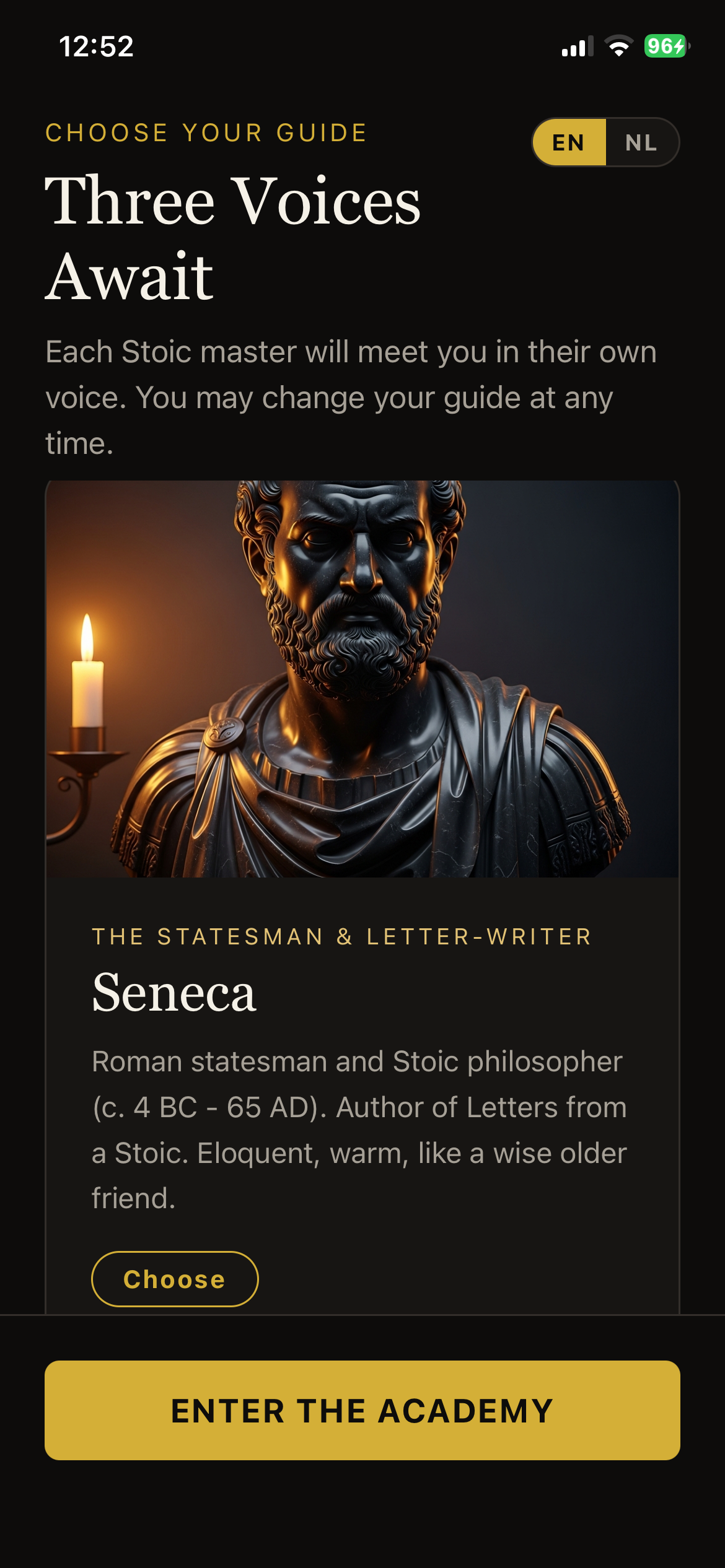
The Statesman & Letter-Writer
Seneca
Roman Statesman · c. 4 BC – 65 AD
Seneca was a senator, advisor to an emperor, playwright, and one of the wealthiest men of his age, a complicated figure whose letters to his friend Lucilius remain the warmest entry point into Stoic thought.
Where Marcus is private and terse, Seneca is generous and conversational. He writes about money, friendship, time, anger, grief and ambition with the candor of someone who has lived through all of them and is still trying to live them well.
The Seneca AI guide in speaks in that voice: eloquent, warm, like a wise older friend who has a desk full of letters open and time to write you one.
The friend you didn't know you needed
Most Stoic writing is austere. Seneca isn't. He is the friend who picks up your letter, takes it seriously, and writes back at length, about ambition, anger, money, grief, the way you spend your hours.
The Seneca AI guide in is built to feel like that correspondence. You write what is happening. The Guide writes back with warmth, candor, and the wisdom of the Letters.
We suffer more often in imagination than in reality.
Seneca on time, money and ambition
Seneca's recurring subject is time, and how casually we spend the one resource we cannot earn back. He writes the same way about money and ambition: as fine servants and ruinous masters.
If you find yourself rich in money but poor in attention, or full of plans but short of meaning, Seneca has been there. The Seneca AI guide brings his counsel into a daily practice that is gentle on you, but honest.
Why Seneca, today
Stoicism has a reputation for being cold. Seneca disproves that single-handedly. He is the Stoic for people who do not want a drill sergeant, but a generous, observant friend who will ask the right question over a glass of wine and not flinch from the answer.
Common questions
People also ask.
Can philosophy improve my daily life?
Stoic philosophy was always meant for daily life. Marcus wrote Meditations as a private journal, not a treatise. Practical philosophy improves daily life by giving you a stable framework for what matters (virtue, judgment, the present moment) and what doesn't (other people's opinions, outcomes outside your control). is built on this premise: small, repeatable Stoic practices that show up in how you handle email, conflict, anxiety and ambition, not as theory but as habit.
How can I develop wisdom?
Wisdom is what is left over after information has been tested by experience and reflection. To develop wisdom, slow down, examine your assumptions, ask better questions, and let your conclusions be challenged by people who have already walked the road: sages like Marcus, Seneca and Epictetus. is, in effect, a wisdom coach: a daily practice that pairs Stoic reading with reflection prompts and an AI dialogue that helps you turn knowledge into lived wisdom.
What is an AI Stoic Coach?
An AI Stoic Coach is an AI guide trained on the primary texts of Marcus Aurelius, Seneca and Epictetus that helps you think through the Stoic way: examining your impressions, testing them against virtue, and choosing an action you can defend on reflection. Unlike a generic chatbot, an AI Stoic Coach is bounded by a moral framework of practical philosophy, not productivity tips, and aims at self-knowledge and better judgment.
What is ?
is an AI-powered Stoic wisdom coach by StoicOs, designed to help you develop self-knowledge, better judgment, character and emotional resilience. You converse with guides inspired by Marcus Aurelius, Seneca and Epictetus, work through daily Stoic reflections, and apply our Common Sense by Virtue™ framework to real decisions. It is not a meditation app, a quote feed, or a note-taker. It is a small, deliberate practice for becoming a wiser, calmer human being.
Begin the practice
Start practicing with .
is now available in the App Store and Google Play.