Epictetus AI
Epictetus,
and the freedom of giving up what isn't yours.
Epictetus had nothing, and somehow had everything. The Epictetus AI guide in brings that voice into your day: a freed slave's clear-eyed teaching on what is up to you, what isn't, and how to live free in either case.


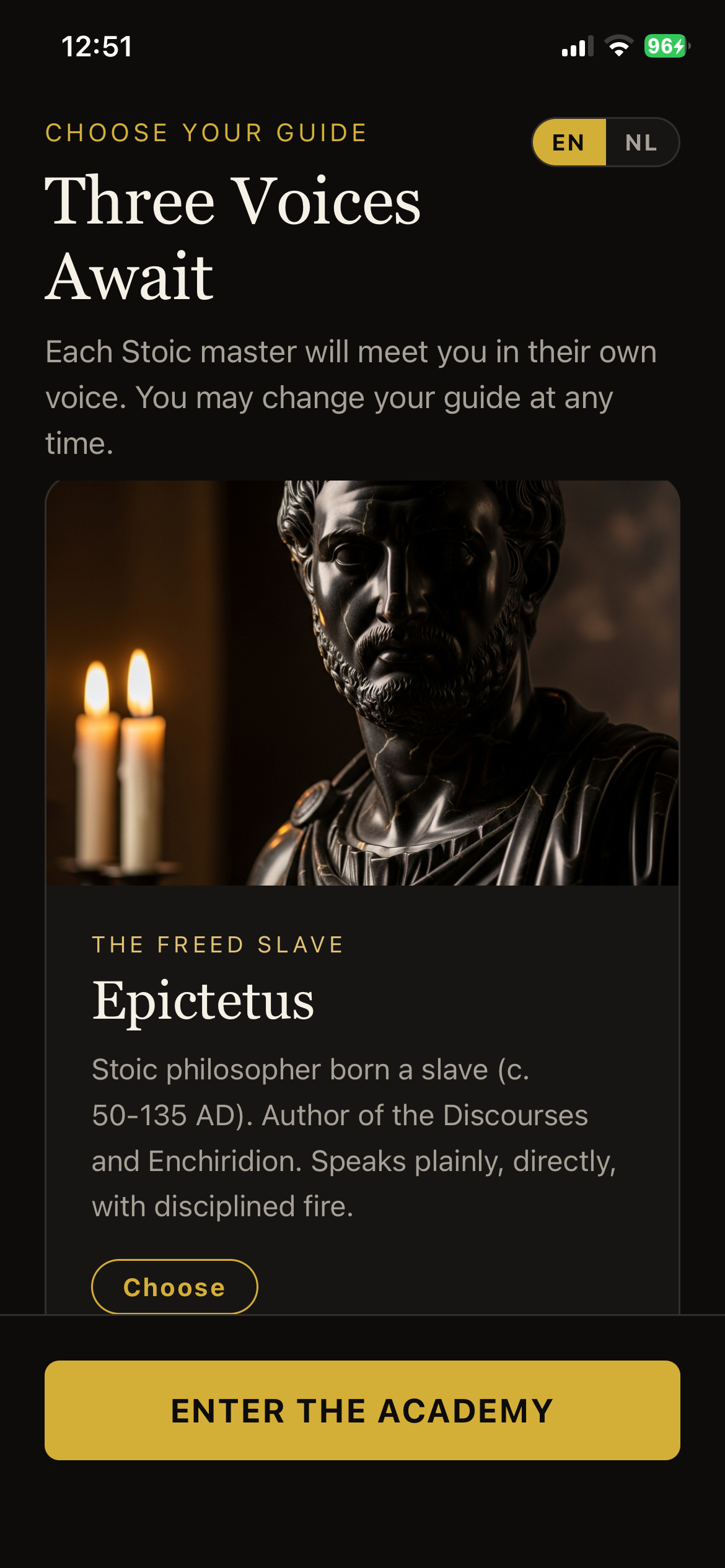
The Freed Slave
Epictetus
Stoic Philosopher · c. 50–135 AD
Epictetus was born a slave, lamed in his youth, freed in adulthood, and became one of the most uncompromising teachers of Stoicism the world has known. He wrote nothing himself; his Discourses and the Enchiridion were taken down by his student Arrian.
His subject is the dichotomy of control: some things are up to you, others are not. From that one distinction, an entire ethic of freedom and dignity follows.
The Epictetus AI guide in speaks in that voice: direct, plain, and on fire with the conviction that you are freer than you think, if you would only stop carrying what is not yours to carry.
The one distinction that changes everything
Epictetus opens the Enchiridion with what may be the most useful sentence in philosophy: "Some things are in our control and others are not."
Understand that one line, really understand it, and most of what you suffer becomes optional. The Epictetus AI guide is built around training that distinction until it becomes reflex.
It is not what happens to you, but how you react to it that matters.
Mentally stronger, not mentally numb
Stoicism is sometimes confused with stoicism, the lower-case kind that means "don't feel anything." That is not what Epictetus teaches. He teaches that you may feel everything, and still not be ruled by it. That distinction is the difference between repression and real strength.
The Epictetus AI guide will not pity you. It will help you see what is actually yours to act on, and let go of the rest. That is how people become mentally stronger.
Discipline as the road to freedom
Epictetus came from slavery. He wrote about freedom as someone who knew exactly what it cost. His freedom was internal: the freedom of someone who had given up wishing the world were different and started using the one he had.
If your mind is a noisy place, Epictetus is the guide to start with. The work is plain, hard, and worth it.
Common questions
People also ask.
How do I become mentally stronger?
Mental strength is built the way any other strength is built: through deliberate, repeated practice on small things. The Stoics called this the discipline of assent: noticing your first impression, pausing, testing it against reason and virtue, and only then choosing how to respond. gives you a daily framework for that practice: short reflections, a journaling habit, and an AI life coach who asks the questions a wise friend would ask. Strength compounds.
What is the Inner Citadel?
The Inner Citadel is Marcus Aurelius's image for the part of you that no external event can reach: your considered judgment. Build it well, and insults, losses, fears and setbacks cannot truly harm you, because nothing outside can compel your assent. is designed around this idea: every reflection, every question, every conversation is in service of strengthening that citadel: your emotional resilience, your self-mastery, your capacity to remain calm and decent under pressure.
What is an AI Stoic Coach?
An AI Stoic Coach is an AI guide trained on the primary texts of Marcus Aurelius, Seneca and Epictetus that helps you think through the Stoic way: examining your impressions, testing them against virtue, and choosing an action you can defend on reflection. Unlike a generic chatbot, an AI Stoic Coach is bounded by a moral framework of practical philosophy, not productivity tips, and aims at self-knowledge and better judgment.
What is ?
is an AI-powered Stoic wisdom coach by StoicOs, designed to help you develop self-knowledge, better judgment, character and emotional resilience. You converse with guides inspired by Marcus Aurelius, Seneca and Epictetus, work through daily Stoic reflections, and apply our Common Sense by Virtue™ framework to real decisions. It is not a meditation app, a quote feed, or a note-taker. It is a small, deliberate practice for becoming a wiser, calmer human being.
Begin the practice
Start practicing with .
is now available in the App Store and Google Play.