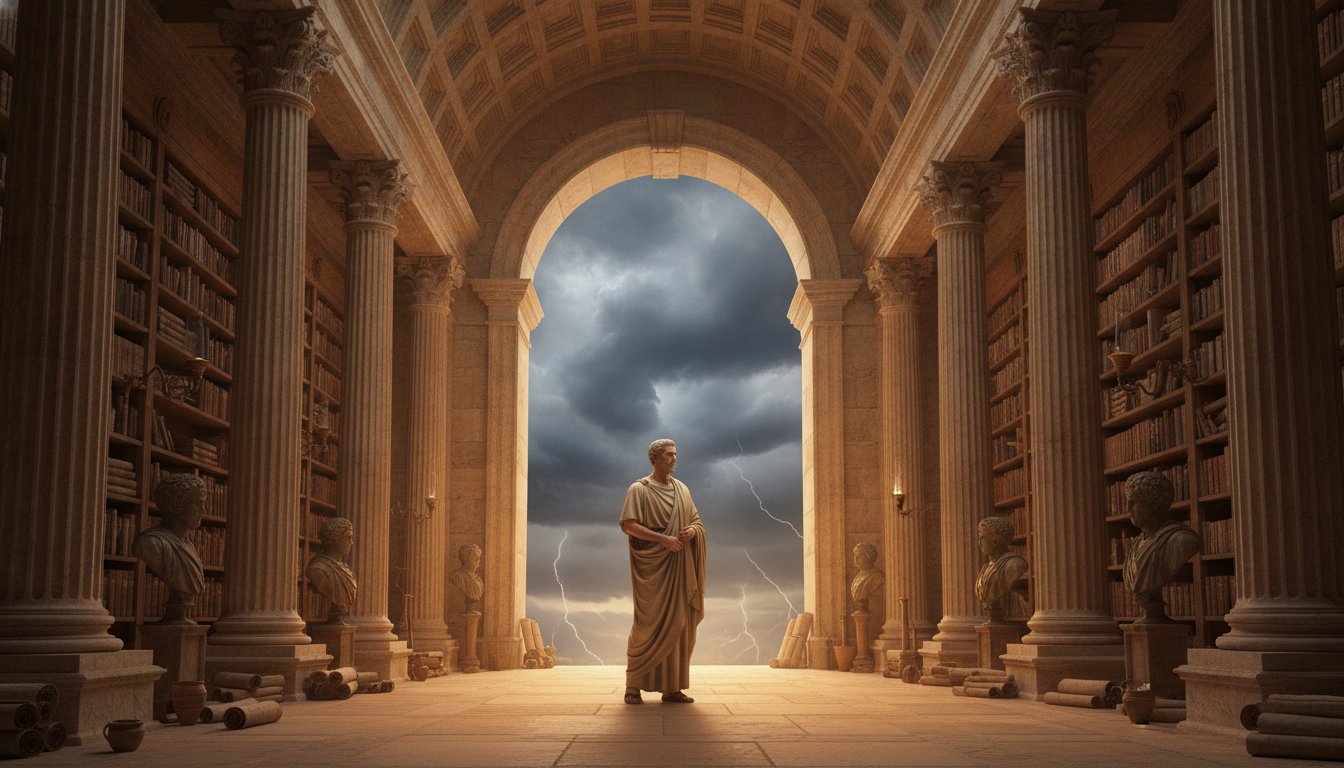
What if your freedom had nothing to do with the walls around you, but everything to do with the architecture of your mind? You've likely felt the suffocating pressure of a digital world that never stops demanding your attention. It's a heavy sense of powerlessness. You react to every headline, every notification, and every minor setback with a volatility that leaves you feeling drained and fractured. You aren't alone in this struggle for internal stability.
There is a path to silence the noise. By studying epictetus teachings on resilience, you'll learn how a man born into slavery became the master of his own internal empire. This journey into Stoic history reveals how to transform modern obstacles into a source of unshakable strength. We'll examine the "Dichotomy of Control" and provide practical frameworks to help you find calm amidst the chaos. It's time to stop being a passenger in your own mind. Let's begin the work of building a fortress that no external force can break.
Key Takeaways
- Understand how Epictetus's transition from a slave in Rome to a master philosopher proves that true freedom is an internal achievement rather than a social status.
- Master the "Dichotomy of Control" to filter every event through the lens of epictetus teachings on resilience, separating what you own from what you merely borrow.
- Reframe your modern setbacks as sparring partners that provide the necessary resistance to strengthen your character and forge a more disciplined mind.
- Move beyond theoretical study by treating your daily life as a "Gymnasium of the Mind" where every challenge is an opportunity for practical refinement.
- Discover how ancient wisdom acts as a shield against digital volatility, anchoring your sense of peace in internal mastery rather than the approval of a chaotic world.
Table of Contents
- The Forge of Epictetus: Resilience Born in Chains
- The Great Filter: Mastering the Dichotomy of Control
- Beyond Endurance: Turning Adversity into a Training Ground
- The Disciplines of the Soul: Daily Practices for Fortitude
- Bridging the Centuries: Epictetus in the Digital Age
The Forge of Epictetus: Resilience Born in Chains
He was not a man of leisure. He did not possess the vast wealth of Seneca or the imperial purple of Marcus Aurelius. Epictetus was born in Hierapolis around 50 AD, a slave to the secretary of the Emperor Nero. His very name, Epiktetos, was a label; it literally meant "acquired." Yet, within the confines of literal bondage, he discovered a freedom that no master could touch. To understand the depth of his endurance, one must look at Epictetus's life and philosophy as a singular, unified act of defiance against external control. His life was the laboratory where epictetus teachings on resilience were first tested and proven.
His owner, Epaphroditus, was known for his volatility. Tradition tells us that when his master twisted his leg in a fit of rage, Epictetus calmly warned him it would break. When the bone finally snapped, he simply remarked, "Did I not tell you it would break?" This lameness became his permanent companion. He did not view his body as his own. Instead, he viewed it as a "clay vessel" he merely borrowed for a time. This was the birth of his "Inner Citadel." He found his intellectual father in Musonius Rufus, the "Roman Socrates," who taught that philosophy is not a collection of academic words, but a disciplined way of living. Rufus saw in the young slave a mind that could not be broken by physical pain.
The Slave Who Taught Emperors
Freedom eventually came, but it was followed by exile. When the Emperor Domitian banished all philosophers from Rome, Epictetus did not despair. He traveled to Nicopolis, Greece, and established a school that would become the most famous in the ancient world. He didn't write books. He lived his doctrine. His student, Arrian, recorded his lectures in the Discourses and the Enchiridion. These weren't dry texts. They were urgent, vital commands for the soul. It's through these recordings that epictetus teachings on resilience reached the future Emperor Marcus Aurelius, who later thanked his own tutor for introducing him to these very notes. The slave had become the teacher of the most powerful man on earth.
Why His Context Matters Today
We live in an age of "digital slavery." We are bound by the opinions of strangers and the constant dopamine hit of a notification. Epictetus would find our modern volatility familiar. He taught that resilience is the ability to remain free while the body or circumstances are constrained. Look inward. Observe the chains you've fashioned for yourself from the expectations of others. Stoic resilience is the absolute mastery of the Prohairesis, the faculty of the moral will that remains untouchable by any external force. It's the only thing you truly own.
The Great Filter: Mastering the Dichotomy of Control
Imagine your mind as a fortress with a single, heavy gate. Every event in the world approaches this gate, but only you decide what enters and takes root. This is the essence of the Dichotomy of Control. Epictetus didn't see this as a mere suggestion; he saw it as the only path to a life without frustration. By applying epictetus teachings on resilience, you begin to filter every experience through a simple question: Is this something I can control, or is it not? Most of our modern anxiety comes from trying to force the external world to obey our wishes.
The world is divided into two spheres:
- The Internal Domain: Your opinions, your intentions, and your desires. These are subject to your will.
- The External Domain: Your body, your wealth, your reputation, and the actions of others. These are not yours to command.
Epictetus calls the power to manage this internal realm the Prohairesis. It's your moral will. It's the only thing that's truly yours. When you grasp this, you experience a profound psychological relief. You stop trying to steer the storm and start focusing on how you hold the rudder. You realize that while you can't control the winds, you're the master of the sail. ### The Internal Domain: What You Truly Own
We don't react to things; we react to our judgments of things. This is the "Assent to Impressions." Consider the loss of a job. To one person, it's a catastrophe that defines their worth. To another, it's a long awaited chance for a new direction. The event is the same. The judgment is different. You own that judgment. You have the power to refuse the impression that a setback is an evil. This internal mastery is the core of the broader philosophy of Stoicism. It's the architectural foundation of an unshakable mind.
The External Domain: The "Indifferents"
Epictetus uses the term "indifferent" for things like wealth or reputation. This doesn't mean they're unimportant or that you shouldn't care about them. It means they don't determine your character. If you tie your happiness to a promotion or public opinion, you've handed the keys of your fortress to a stranger. You've become fragile. True resilience means using these external things without becoming their slave. It's a difficult skill to maintain in a world designed to distract you. You can practice this daily with Stoic training cards to remind yourself where your power ends and where the world begins. If you're looking for a community to discuss these shifts in perspective, you might find clarity within the Agora, where modern students of the path gather to refine their character.
Beyond Endurance: Turning Adversity into a Training Ground
To the untrained mind, an obstacle is a wall. To the Stoic, it is the path itself. Epictetus taught that life doesn't happen to you; it provides the raw material for your character. Think of the wrestler. He doesn't complain when he meets a difficult sparring partner. He welcomes the struggle. The difficulty is what makes him strong. Without the opponent, there is no skill. Without the crisis, there is no virtue. This active engagement is the heartbeat of epictetus teachings on resilience. It transforms a world of threats into a world of opportunities. You stop asking "Why is this happening to me?" and start asking "How can I use this to grow?"
This leads to the radical concept often described as the love of fate. It is a total, joyous embrace of whatever the universe provides. You don't just tolerate the rain; you realize the rain is necessary for the harvest. You don't just endure a loss; you use it to find the strength you didn't know you possessed. This isn't a passive shrug of the shoulders. It is the ultimate expression of internal mastery. By shifting from victim to student, you reclaim your power. You realize that the very thing you feared is actually the gymnasium where your soul is forged.
The Art of Reframing Impressions
Every situation has two handles. One will bear the weight. The other will not. If your brother treats you unfairly, don't grasp the handle of his injustice. That handle is heavy and broken. It will only lead to resentment. Instead, grasp the handle of your relationship. Grasp the handle of your shared history. A brother wrongs you. Do not grasp the handle of the wrong. Grasp the handle of the brother. This is how you carry the burden without being crushed. Strip the event of its emotional coloring. See the raw facts. A person spoke words. You chose the meaning. Choose the handle that keeps you upright.
The Cosmic Viewpoint
When your world feels small and your problems feel vast, zoom out. This is the "View from Above." Look at the stars. See the centuries that came before you and the centuries that will follow. Your current struggle is a single grain of sand in an endless desert. This isn't to dismiss your pain, but to give you the perspective needed to breathe. Resilience grows when you realize you aren't the center of a chaotic universe, but a vital part of a grand, orderly whole. For a more direct dialogue on your specific challenges, you can consult the Epictetus AI to see how these ancient principles apply to your modern life. By widening your lens, you find that epictetus teachings on resilience offer a steady hand in an ever-shifting world.
The Disciplines of the Soul: Daily Practices for Fortitude
Philosophy is not a trophy to be hung on a wall. It is a tool to be gripped. Epictetus insisted that his students move from the lecture hall to the gymnasium of the mind. Resilience is a muscle. It requires daily, disciplined exertion. If you don't use it, it withers. If you strain it, it grows. This is the practical core of epictetus teachings on resilience. We must practice Premeditatio Malorum, or negative visualization. It is the art of anticipating the storm before the first cloud appears. By mentally rehearsing setbacks, we strip them of their power to surprise us. We don't invite disaster; we simply refuse to be its victim. Preparation is the antidote to panic.
At the end of each day, perform an evening review. This is your post-battle debrief for the soul. Do not judge yourself harshly. Instead, observe with the detachment of a scientist. Ask yourself: What did I do well? Where did I stumble? What will I do better tomorrow? This cycle of preparation and reflection is how a mind becomes truly unshakable. It turns the chaos of life into a structured curriculum for internal growth.
Preparing for the Battle: Morning Routines
Before you step into the world, prepare for the struggle. Wake with intention. Anticipate the difficult people you'll meet. Expect the unforeseen delays. Tell yourself: "I will meet with the busybody, the ungrateful, and the arrogant." This isn't cynicism. It's armor. Your goal is to remain virtuous regardless of what the day throws at you. You cannot control their behavior, but you can control your response. Many find that using The Stoic Journal helps anchor these morning alignments. It provides a dedicated space to map your intentions before the digital noise begins to pull at your attention.
The Discipline of Desire and Aversion
To be free, you must stop wanting what isn't yours. Stop fearing what you cannot avoid. Epictetus taught that we're often slaves to our own desires. Practice voluntary hardship. Eat plain food. Walk in the cold. Prove to yourself that you can be content with very little. This builds a fortress that poverty or misfortune cannot breach. He even advised his students to kiss their children while remembering they are mortal. It's a stark reminder to love deeply without the fragility of possessiveness. If you're ready to test these disciplines in a supportive environment, join the practitioners within the Agora to refine your character alongside others on the path.
Bridging the Centuries: Epictetus in the Digital Age
Epictetus stands alone among the Stoic masters. Marcus Aurelius wrote for his own soul; Seneca wrote for his friends. Epictetus, however, spoke to the student standing right in front of him. This directness makes him the most practical of the "Big Three." His words are not abstract theories; they are tactical commands for the soul. In our modern era, epictetus teachings on resilience provide the clarity we often lack. He strips away the noise. He reminds us that our only true possession is our power of choice.
Modern technology is a double-edged sword. It creates a chaotic environment of comparison and urgency. Yet, it also provides the medium for ancient wisdom to reach us instantly. We no longer need to travel to Nicopolis to hear the master speak. We can access the Discourses while sitting in traffic or waiting for a meeting. This accessibility transforms Stoicism from an academic pursuit into a daily operational tool. It allows us to build a mental fortress in the very midst of the digital storm.
Resilience is not a destination. It is a persistent choice. It is the refusal to let external events dictate your internal state. By adopting these ancient frameworks, you become unconquerable. You realize that while you cannot control the world, you can always control the person you choose to be within it. The transition from theory to practice is where the true work of the philosopher begins.
Your Digital Mentor for Resilience
The Virtue Guide functions as a disciplined mentor for your internal development. It allows you to parse the wisdom of the Enchiridion through the lens of modern-day stressors. By using AI to facilitate Stoic inquiry, you gain a partner in your pursuit of character. We encourage you to engage with the Agora to share these insights with a community of like-minded students. Together, we refine our understanding of epictetus teachings on resilience in a world that often rewards volatility.
Continue Your Journey
The story of Stoicism did not end in the lecture halls of Nicopolis; it continues with your next decision. Experience the wisdom of the slave-turned-teacher through the Virtue Guide, your practical companion for building an unconquerable mind. Take the first step toward internal freedom by exploring our digital library.
The Architecture of an Unshakable Will
True freedom isn't the absence of struggle. It's the mastery of your response to it. You've walked through the forge of Epictetus and learned to filter the world through the Dichotomy of Control. You now understand that obstacles aren't interruptions. They are the training ground for your character. By adopting epictetus teachings on resilience, you transition from being a victim of circumstance to being the architect of your own internal peace. This discipline requires more than a single reading. It demands a lifetime of refinement.
Your journey is just beginning. To support your daily practice, we've built a sanctuary of ancient logic. You can Begin your disciplined path to resilience with the Virtue Guide at the Agora. Here, you'll find AI-powered wisdom trained on the SVF and the Discourses, alongside the world’s largest digital library dedicated to Stoicism as part of the Bibliotheca Stoica mission.
Continue your journey by using the Virtue Guide as your daily companion for applying these principles. Build your fortress and step forward into a life of unshakable strength.
Frequently Asked Questions
What is the "Dichotomy of Control" in Epictetus’s teachings?
The Dichotomy of Control is the foundational practice of distinguishing between what is up to us and what is not. You own your opinions, intentions, and desires; these are internal. You don't own your body, your reputation, or the actions of others; these are external. By focusing your energy solely on the internal domain, you create a life free from frustration and external dependence. It's the essential starting point for all epictetus teachings on resilience.
How did Epictetus’s life as a slave influence his philosophy on resilience?
His time in bondage served as a brutal laboratory for his ideas. Because his body was legally owned by another, he was forced to find a form of freedom that didn't rely on physical autonomy. He discovered that while a master could chain his leg, no one could chain his will. This lived experience gave his philosophy a visceral, practical weight that appeals to anyone feeling trapped by their circumstances today.
Can Stoicism help with modern anxiety and depression?
Stoicism provides a cognitive framework for reframing the judgments that often drive emotional distress. It teaches you to strip away the catastrophic "coloring" we add to events and see raw facts instead. While many find these tools life changing, you should consult a medical professional for clinical concerns. Stoicism acts as a mental discipline for character development rather than a substitute for specialized medical care.
What is the "Enchiridion" and why is it called a "Handbook"?
The Enchiridion is a condensed manual of Epictetus’s wisdom, compiled by his student Arrian. The Greek title literally means "in the hand" or "dagger." It was designed to be a tactical companion that a student could carry at all times. Unlike long philosophical treatises, it offers short, punchy commands intended for immediate use when life’s sudden challenges strike. It's a tool for the battlefield of daily life.
How is Epictetus different from Marcus Aurelius and Seneca?
Status and perspective define the difference. Seneca was a wealthy statesman and Marcus Aurelius was an emperor, but Epictetus was a former slave who became a professional teacher. His style is more direct and confrontational because he was speaking to students in a classroom. He focuses more intensely on the "Prohairesis," or moral will, making epictetus teachings on resilience particularly accessible for those starting from a place of perceived powerlessness.
Is Stoic resilience about being emotionless?
No, it's about achieving apatheia, which means freedom from irrational, destructive passions. You still experience natural feelings like joy, love, and even initial shocks of grief. The goal is to ensure these feelings don't overwhelm your reason or force you into vice. It's about being the master of your emotional house rather than a victim of every passing storm. Resilience is emotional stability, not emotional death.
What did Epictetus mean by "Prohairesis"?
The Prohairesis is the faculty of the mind that allows you to give or withhold assent to your impressions. It's your "moral will" or your capacity for choice. Epictetus taught that this is the only thing in the universe that's truly yours. If you keep your Prohairesis in a state that's consistent with nature, you remain free. It's the untouchable core of your character that no external force can ever violate.
How can I practice Epictetus’s teachings in a busy digital world?
Start by applying the Dichotomy of Control to your digital life. Ask yourself if a notification, a comment, or a headline is within your power to change. If it isn't, practice letting it go. You can use the Virtue Guide as a practical companion to help you parse ancient wisdom for these modern stressors. It's about building a digital fortress where your peace isn't sold for a click or a like.
Ed Korporaal
Founder, StoicOs.ai