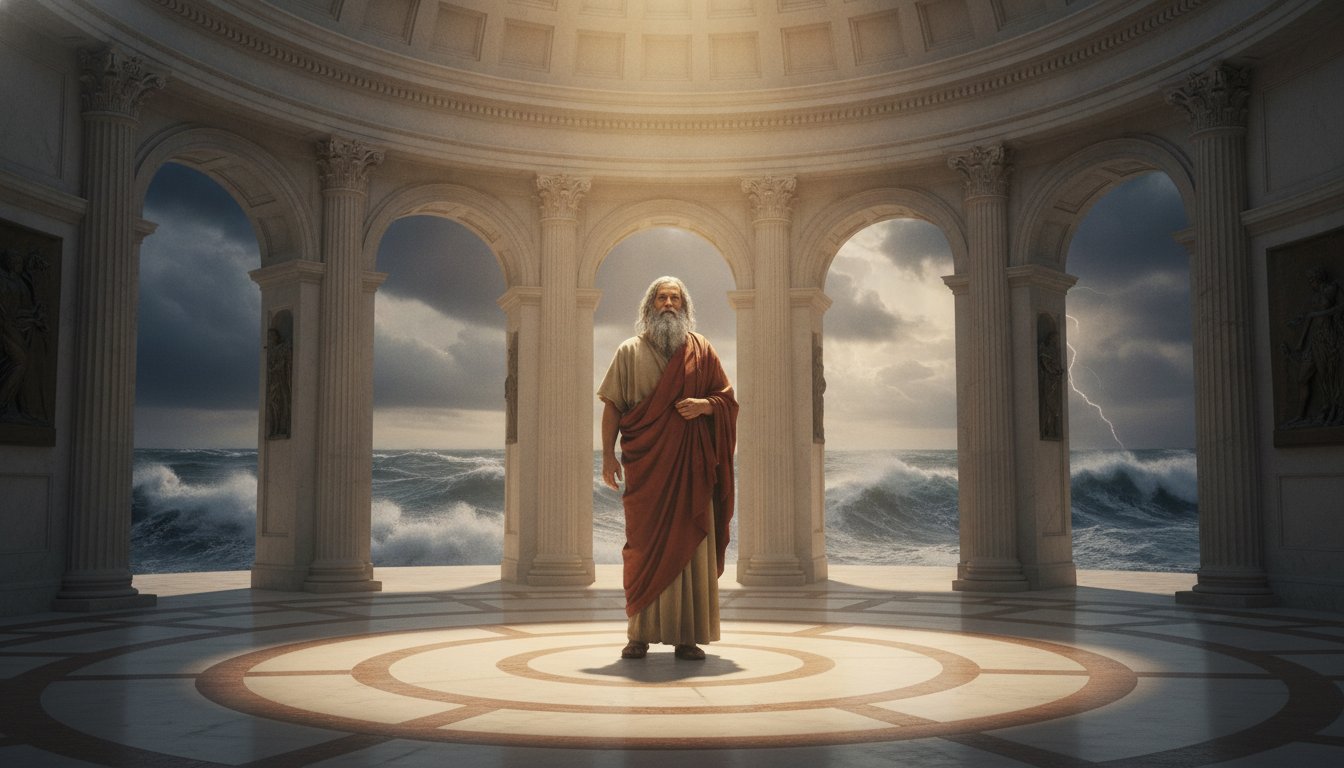
Leadership is not an external rank to be held. It is an internal architecture of character to be built. When a crisis arrives, your title offers no sanctuary. You likely feel the heavy burden of decision fatigue during high-stakes moments. You know the exhaustion of emotional volatility when your best efforts fail to move the needle. It's difficult to maintain a sense of justice in cultures that reward speed over substance. Many modern strategists are turning to stoic principles for leadership to find a sense of permanence in a world of constant flux.
We agree that the weight of responsibility can feel isolating when the path forward is clouded. This article promises to show you how 2,300 years of Stoic wisdom can transform your leadership from a title into a profound architecture of character. We'll explore a repeatable framework for making ethical decisions and building the resilience required to stand firm during any storm. Join us as we continue this journey through history. We will examine how ancient wisdom provides a steady hand for the modern commander.
This chapter examines the internal architecture of command through these lenses:
- The lineage of authority. Trace the evolution of leadership from Zeno’s initial vision to Chrysippus’s focus on social duty.
- The four pillars of character. Discover how stoic principles for leadership create an ethical framework through wisdom, justice, courage, and temperance.
- The resolution of the Leader’s Paradox. Master the dichotomy of control to own your efforts while releasing the weight of results that aren't yours to decide.
- The construction of the Inner Citadel. Learn from Marcus Aurelius how to build a mental sanctuary that remains safe from external turmoil.
- The modern companion. Explore how the Virtue Guide integrates ancient wisdom into your daily practice of refinement.
Table of Contents
- The Genesis of Authority: How Stoic Leadership Evolved from Zeno to the Roman Empire
- The Four Pillars of the Stoic Executive: Wisdom, Justice, Courage, and Temperance
- Navigating the Storm: The Dichotomy of Control for Modern Decision-Makers
- The Burden of Command: Building the Inner Citadel with Marcus Aurelius
- Scaling Philosophical Leadership: Integrating Ancient Wisdom with the Virtue Guide
The Genesis of Authority: How Stoic Leadership Evolved from Zeno to the Roman Empire
Leadership didn't begin in a boardroom or a palace. It began on a painted porch in Athens. Around 300 BC, a shipwrecked merchant named Zeno of Citium lost his fortune but found a purpose. He realized that external wealth is a "preferred indifferent." It's not the source of true power. He began teaching that authority isn't something granted by a crown. It's something forged in the soul. These early stoic principles for leadership shifted the focus from what a leader has to who a leader is. This was the birth of Stoic philosophy as a practical tool for governance.
The Cosmopolitan Leader: Zeno’s Vision of Global Duty
Zeno proposed a radical idea: the Cosmopolis. He envisioned a world city where all people are fellow citizens. For a leader, this means rejecting tribalism. It means looking past the narrow interests of a single department or region. A leader’s duty is to the whole. This concept was later refined by Chrysippus through the idea of Oikeiosis. This is the natural process of expanding our circle of concern. We start with ourselves. We move to our family. We eventually include our team, our company, and humanity itself. Leading a diverse, global team today requires this exact mindset. It demands a unified ethical standard that transcends borders. Fairness isn't a local policy. It's a universal law.
Why Virtue is the Only True Rank
The Stoics were clear on one point. Virtue is the only true good. Everything else is secondary. They argued that a wise person in chains is more of a leader than a foolish king on a throne. Why? Because the wise person commands their own mind. True authority flows from self-mastery. If you cannot lead yourself, you cannot lead others. This mindset forces modern executives to stay humble. It strips away the ego of the title. It focuses purely on meritocracy and character. Rank is a temporary assignment; character is a permanent architecture. As these stoic principles for leadership moved from Athens to Rome, they met the practical needs of a growing empire. They became the "operating system" for emperors and generals who faced the weight of the world.
Continue your journey. Explore the practical tools of the ancient masters with the Virtue Guide, your companion for daily reflection and character building.
The Four Pillars of the Stoic Executive: Wisdom, Justice, Courage, and Temperance
Think of the four cardinal virtues not as abstract ideals, but as the hard-coded operating system for your character. In the ancient world, these principles weren't reserved for quiet libraries. They were the armor worn by men like Cato the Younger. Cato stood as a singular pillar of resistance against the corruption of Julius Caesar. He didn't do this through raw power; he did it through the relentless application of stoic principles for leadership. His authority came from the fact that his actions were always filtered through a specific architecture of virtue.
These virtues are deeply interdependent. You can't possess one fully without the others. Courage without Justice is mere cruelty. Temperance without Wisdom is just empty habit. When you enter a board meeting or draft a difficult email, these four pillars serve as your final review. They ensure your response isn't a reaction to external pressure, but an expression of internal strength. By integrating these values, you move beyond the frantic pace of modern management into a more deliberate, grounded way of being.
Practical Wisdom (Phronesis) in Strategy
Phronesis is the art of seeing the world as it is, not as we wish it to be. It's the primary tool for any strategist. In high-stakes environments, emotional bias often clouds the data. We want the market to recover. We wish the competitor hadn't launched that product. Practical wisdom strips these desires away. It allows you to look at a failing project with the cold clarity of a surgeon. By focusing on what is true rather than what is comfortable, you make decisions based on reality. This logical refinement is how you transform stoic principles for leadership into a genuine competitive advantage.
Justice and Temperance: Building a Sustainable Culture
Justice is more than legal compliance. The Stoics called it Koinonikon, or the commitment to the common good. A leader who practices Justice builds unbreakable loyalty because the team knows the leader's interests are aligned with theirs. Fairness is the bedrock of trust. Temperance complements this by providing self-regulation. It's the ability to manage the ego of the executive. It prevents the impulsive decision born of anger or the reckless expansion born of greed. To practice this today, try evaluating your last major decision against these filters:
- Was it wise and based on objective truth?
- Was it just and fair to all stakeholders?
- Was it courageous, doing what was right rather than what was easy?
- Was it temperate, showing restraint instead of impulse?
Refining these internal states takes consistent effort. You can begin this practice by using the Virtue Guide to track your daily alignment with these four pillars. It acts as a digital companion for the serious pursuit of internal development.
Continue your journey. As you master these internal filters, you'll find that the external chaos of the world begins to lose its power over your peace of mind.
Navigating the Storm: The Dichotomy of Control for Modern Decision-Makers
Leadership often feels like a weight you cannot put down. You are held accountable for the market, the weather, and the whims of competitors. Epictetus, born into slavery but a master of his own mind, taught us that this weight is an illusion. He began his Enchiridion with a simple, sharp distinction: some things are up to us, and some are not. This is the foundation of stoic principles for leadership. Within your power are your opinions, intentions, and your own actions. Outside your power is everything else. When you internalize this, the "Leader’s Paradox" dissolves. You accept total responsibility for your efforts while releasing the burden of outcomes you don't fully control.
Antipater of Tarsus, a later head of the Stoa, used the metaphor of the archer to clarify this. The archer chooses the arrow. He strings the bow. He aims with precision. But once the arrow leaves the string, the hit is no longer up to him. A gust of wind or a sudden move by the target can change the outcome. Your job is the aim. Your excellence is in the release. The target is merely a "preferred indifferent." By shifting your focus to the internal process, you reduce executive stress and prevent the exhaustion that comes from fighting the inevitable.
Outcomes vs. Efforts: Reframing KPIs and Goals
KPIs are necessary, but they are dangerous if tied to your personal worth. The Dichotomy of Control is the leader’s ultimate shield against anxiety. When you set a target, use the Stoic "Reserve Clause," or hupexhairesis. This is the mental addition of "fate permitting" to every plan. You intend to hit the quarterly target, but you accept that external disruptions are possible. This isn't passivity. It's a calculated focus on the internal process. You command your effort. You surrender the result. This refinement of intent allows you to lead with intensity without being shattered by a market shift.
Leading Without Attachment to Results
In the maze of corporate bureaucracy, you will face "hindrances." Epictetus taught that nothing can hinder the will unless you allow it. If a project fails due to an economic shift, a Stoic leader remains steady. The failure is external; the character remains intact. Train your team to see the world this way. Shift their focus from the "win" to the "work." When the team masters their internal state, burnout disappears. They become a resilient force that cannot be shaken by market volatility. These stoic principles for leadership transform a frantic office into a disciplined citadel.
Continue your journey. Practice the dichotomy of control in real-time with the Virtue Guide, your daily companion for maintaining a steady hand in an uncertain world.
The Burden of Command: Building the Inner Citadel with Marcus Aurelius
Marcus Aurelius was not a philosopher king living in a vacuum of peace. Between 161 and 180 AD, he held the weight of the Roman Empire while facing the Antonine Plague, relentless border wars, and the stinging betrayal of his trusted general, Avidius Cassius. He remained unbroken. He didn't achieve this through sheer force of will, but through the consistent application of stoic principles for leadership. His private writings, known today as the Meditations, reveal a man building what scholar Pierre Hadot termed the "Inner Citadel." This is the psychological fortress where the mind remains safe from external turmoil. It's a place of absolute clarity within the storm of command.
He understood the temptation of absolute power better than any modern executive. To counter the rot of ego, he practiced a rigorous form of self-reflection. He viewed leadership as a service rather than a right. He believed that the best way to lead was to show the way through action. Marcus didn't merely give orders. He lived the virtues he expected from his legions. This commitment to internal excellence ensured that his character remained stable even when the empire around him was not. By leading through example, he transformed his rank into a profound architecture of influence.
Managing the Ego and Public Criticism
Marcus used a technique called the "view from above" to maintain perspective. He'd imagine looking down on the earth from the stars. From that height, the frantic movements of armies and the petty criticisms of the Roman court seemed insignificant. Modern leaders can use this same cosmic perspective to shrink the overwhelming stress of a market downturn or a difficult board meeting. He also prepared for the friction of human interaction. In Meditations 2.1, he famously reminded himself every morning that he'd meet meddling, ungrateful, and arrogant people. He didn't do this to become cynical. He did it to ensure his own character wouldn't be poisoned by their behavior. By practicing Premeditatio Malorum, or negative visualization, he anticipated crises before they arrived. This allowed him to meet disaster with a steady hand rather than a panicked heart.
The Leader as a Student: The Importance of Continuous Reflection
The Emperor never stopped being a pupil. He credited his mentors, particularly Junius Rusticus, for teaching him to avoid the traps of sophisticated rhetoric and pride. This humility is essential for any modern commander. Marcus wrote to himself every night to audit his actions and refine his thoughts. This ancient practice of self-observation has evolved into the modern digital stoic journal. By recording your internal state, you build a bridge between the person you are and the leader you aim to become. Encourage this same culture of inquiry within your organization. A team of students is always more resilient than a team of experts who believe they've nothing left to learn.
You can begin building your own mental fortress today. Use the Virtue Guide as your practical companion for real-time reflection and character development.
Continue your journey. By mastering the inner citadel, you prepare yourself for the final step of the leader's path: integrating these ancient truths into the digital age.
Scaling Philosophical Leadership: Integrating Ancient Wisdom with the Virtue Guide
The journey from the ancient Stoa to the digital screen is not a departure from tradition. It is its necessary evolution. Today, the velocity of information creates a frantic pace that the ancient masters never knew, yet the core human struggles remain unchanged. Technology requires a foundation of virtue ethics more than ever. Without a disciplined internal compass, the tools of the modern age only amplify our biases and impulses. Integrating stoic principles for leadership into a digital workflow isn't just about efficiency. It's about ensuring that the power we wield is guided by wisdom. The vision of the Bibliotheca Stoica is to provide this necessary support, creating a digital library that serves as a permanent resource for the leader’s long-term growth.
The AI-Powered Philosophical Advisor
Practice is the hardest part of philosophy. Reading the Meditations is one thing; applying them when a major contract is lost is another. StoicOs.ai bridges this gap by turning ancient theory into immediate practice. By using the Marcus Aurelius AI, you can find clarity during high-pressure decisions by engaging with a non-judgmental guide that mirrors the emperor’s own disciplined logic. This advisor doesn't give orders. It prompts you to look inward. It helps you identify the cognitive biases that cloud your judgment. Having the Virtue Guide in your pocket is like having a mentor who never tires and never wavers. It offers a space for real-time reflection that preserves your peace of mind.
Building Your Personal Leadership Framework
A manager reacts to the market. A leader responds with virtue. To move from the former to the latter, you must build a repeatable framework for action. Start by integrating small, Stoic exercises into your executive schedule. Spend five minutes each morning on Premeditatio Malorum. Spend five minutes each evening auditing your choices. These small moments of refinement build the "Inner Citadel" we explored earlier. Every step taken with intention strengthens your character. The path of the Stoic is long. It requires persistence. But it's the only path that leads to a leadership style that inspires loyalty through substance rather than rank. Explore the Virtue Guide to begin your own chapter in this 2,300-year-old story.
Continue your journey. Explore the Virtue Guide to deepen your practice and turn these ancient principles into a living reality.
Forging the Future through Ancient Strength
Leadership is a lifelong refinement of the soul. You've traced the evolution of authority from Zeno’s porch to the digital age. You've seen how wisdom, justice, courage, and temperance form an unbreakable operating system for the character. These stoic principles for leadership are not historical artifacts. They are active tools for the modern executive who seeks stability in an unstable world. By mastering the dichotomy of control and building your own inner citadel, you transform the burden of command into a pursuit of excellence.
It's time to move from theory to practice. We invite you to awaken your inner leader in the Agora. Our platform is the world's leading digital Stoic knowledge environment, featuring AI trained on the original texts of Marcus Aurelius, Epictetus, and Seneca. It's designed for serious internal development, helping you find clarity when the world is loud. Your character is the only thing that remains entirely your own. Protect it with the wisdom of the ages.
Continue your journey. Explore the Virtue Guide as your practical companion for applying these truths and building a leadership style that lasts.
Common Enquiries on the Path of Command
Is Stoic leadership too passive for a competitive business environment?
Stoicism is far from passive. It's a philosophy of intense, directed action. You still pursue preferred indifferents like market share and profit, but you don't tie your internal stability to them. By focusing purely on the excellence of your own efforts, you become a more formidable competitor. You're no longer slowed down by the anxiety of potential loss. You act with a clarity that your rivals often lack.
Does Stoicism mean a leader shouldn't show any emotion to their team?
Stoicism is about the rational processing of emotions, not their elimination. The goal is to avoid destructive passions like rage and fear. A Stoic leader still experiences eupatheiai, which are healthy, rational states like joy and goodwill. You don't become a statue. You become a steady foundation. Your team needs your calm, but they also need your genuine commitment to their well-being and growth.
How can the Dichotomy of Control help me with meeting my quarterly targets?
This principle helps you focus on the inputs that actually produce results. You cannot control the market's reaction, but you can control the quality of your strategy and the discipline of your team. By applying these stoic principles for leadership, you reduce the psychological noise that leads to mistakes. You execute with more precision because your mind isn't divided between the work and the worry over the final number.
What is the most important Stoic virtue for a new manager to develop?
Practical Wisdom, or Phronesis, is essential for those new to command. It's the ability to see things as they truly are, stripped of the ego's projections. A new manager often struggles with the desire to be liked or the fear of being wrong. Wisdom allows you to make decisions based on the common good rather than personal insecurity. It's the foundation upon which Justice and Courage are built.
How did Marcus Aurelius handle difficult employees or betrayals?
He handled them with a combination of preparation and forgiveness. Every morning, he reminded himself that he'd encounter people who were ungrateful or meddling. This prevented him from being surprised or angered by their behavior. When his general Avidius Cassius betrayed him, Marcus didn't seek revenge. He sought to preserve his own character. He understood that the general's betrayal was an external event that didn't have to change his own internal commitment to Justice.
Can Stoicism help with executive burnout and decision fatigue?
Stoicism is a powerful antidote to the exhaustion of high-level command. Burnout often comes from trying to carry the weight of things you cannot control. Decision fatigue sets in when every choice feels like a battle of the ego. By practicing stoic principles for leadership, you learn to release the uncontrollables. This preserves your mental energy for the few things that truly matter. It creates a sense of clarity and mental space.
What is the difference between being a Stoic leader and being a 'cold' leader?
A cold leader is indifferent to the humanity of their team, while a Stoic leader is deeply committed to the Koinonikon, or the common good. Stoicism requires Justice. It requires you to treat every person with fairness and respect. A cold leader lacks empathy; a Stoic leader possesses empathy but isn't ruled by it. You remain warm and helpful, but you don't allow your judgment to be clouded by emotional contagion.
How can I start a Stoic morning routine for my leadership development?
Begin with Premeditatio Malorum, or the visualization of potential difficulties. Spend five minutes anticipating the frictions of the day so they don't catch you off guard. Follow this with a brief period of reflection on your intentions. You might use the Stoic Journal to record which virtues you aim to practice in specific meetings. This intentional start transforms your day from a series of reactions into a deliberate pursuit of refinement.
Continue your journey. Explore the Virtue Guide to deepen your practice and turn these ancient principles into a living reality for your leadership path.
Ed Korporaal
Founder, StoicOs.ai