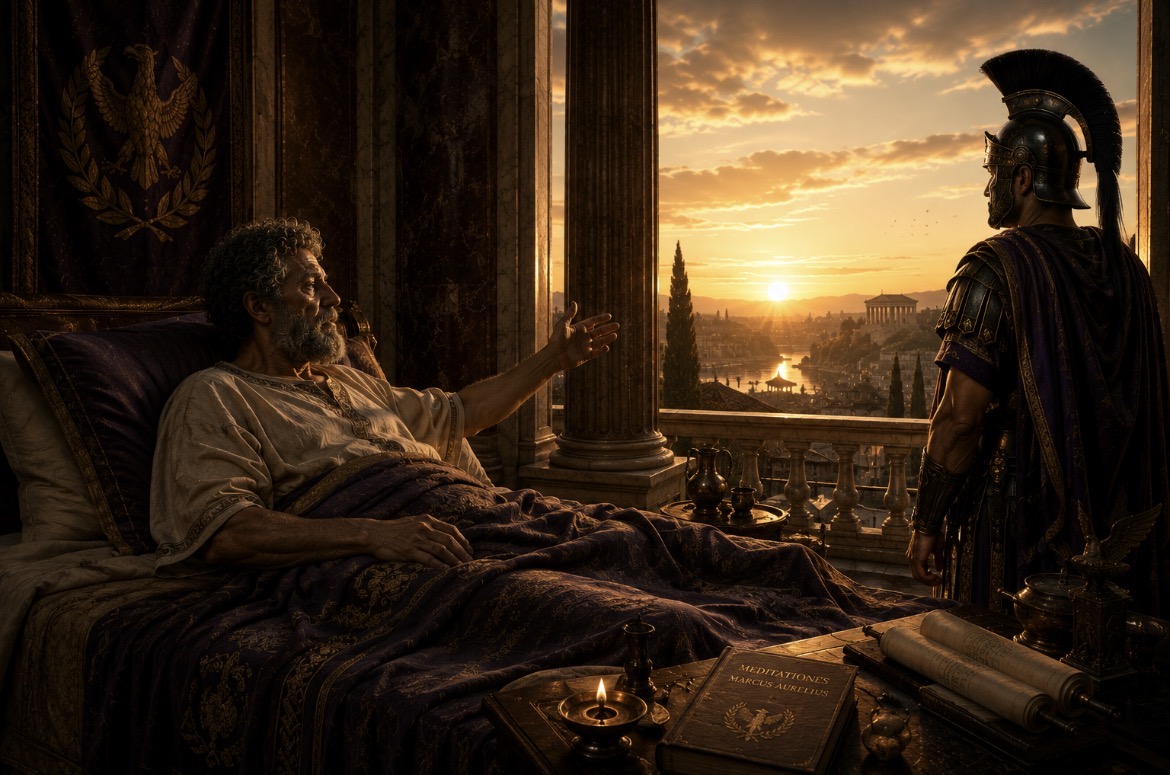
There is a particular kind of night that comes for everyone — sooner or later. The kind where sleep refuses to arrive and the ceiling becomes a slow, unmoving cinema of every regret you carry. For me, that night came in the late autumn of a year I would later struggle to describe.
I had been carrying something heavy for months — a loss that did not photograph well, the slow kind, the kind that happens by degrees. I told no one. I worked. I smiled at the right moments. And then, on a Tuesday evening that looked like any other, the carrying simply stopped working.
I reached for a book I had owned for almost a decade and never properly read. Meditations, by Marcus Aurelius.
"You have power over your mind — not outside events. Realize this, and you will find strength."
It was the first passage I opened to. I read it three times.
The First Lesson — separating the world from my judgement of it
What Marcus does — quietly, page after page — is teach you to separate. To peel apart the event from the story you tell yourself about the event. The loss had happened. That was a fact. But the cascade of meanings I had stitched on top of it — that this proved something, that I had failed, that the future was now smaller — those were not facts. Those were interpretations, and interpretations are mine to revise.
It sounds simple written down. It is not simple in the body. The first time I tried, sitting up in bed at three in the morning, I noticed I could not feel the difference between the loss and what I had decided the loss meant. They had grown together like two trees in a small garden.
But Marcus is patient. He repeats himself, gently, across two thousand years. The impressions, the impressions, the impressions. And slowly — over weeks, not minutes — a small space opened between what happened and what I made of it.
The Second Lesson — the morning has not been promised to you
Some passages I returned to so often that the pages curled. One of them was Seneca, writing to his friend Lucilius about how strange it is that we hoard money but spend our days as if they were infinite:
"It is not that we have a short time to live, but that we waste much of it."
I read this on a Sunday afternoon — the worst kind of Sunday afternoon, the one where the week ahead feels like a long corridor with the lights off. And it occurred to me, perhaps for the first time clearly, that the difficult period was not stealing my life from me. I was. By replaying it, narrating it, defending against it, by refusing to actually live the present hour because the present hour was uncomfortable.
The Stoics do not ask you to feel better. They ask you to act better, while you wait for the feeling to pass. There is a great kindness in that distinction.
The Third Lesson — the practice, not the theory
What changed, in the end, was not my mind. It was my mornings.
I began doing what the Stoics called the praemeditatio — a brief reflection at the start of the day. Not a meditation in the modern sense, not silence, not breath. A short, honest naming. Today I will be interrupted. Today someone may misunderstand me. Today I will want to react badly to something small. Let me already meet these in advance, here, while it is quiet.
And in the evening, the second half of the practice — the examination. Where did I act from fear today? Where did I act well? What did I avoid? No judgement, no scoring. Just a careful walking back through the hours, the way a friend might walk you home.
"Every new beginning comes from some other beginning's end."
— attributed often, but really Seneca, more or less
Six months later — and I want to be honest about the length of that, because nothing about Stoicism is fast — I was sleeping again. Not because the loss had healed. Because I had stopped fighting the night.
Why I am building StoicOs
This is the part I want to be careful with. I did not build StoicOs because I solved anything. I built it because the books, the marginalia, the slow accumulation of practices over those years, became too useful to keep to myself.
Marcus wrote his Meditations to himself, in a tent, on a campaign he did not want to be on. He never imagined a reader. There is something about that absence of audience that makes the writing land. He was not performing wisdom. He was needing it.
I think a lot of people — quietly, in the late hours, when no one is watching — are also needing it. And I do not think they need it dressed up as productivity, or repackaged as a five-step framework, or shouted at them from a self-help bestseller.
They need it the way I needed it. Available. Quiet. Patient. In the voice of someone who has actually lived it.
That is what we are trying to build.
If something in this letter found you, you are welcome to write back. I read every message personally — there is a place for that on the Share Your Thoughts page.
And when Virtue Guide opens, you will be among the first to know.
Ed Korporaal
Founder, StoicOs.ai