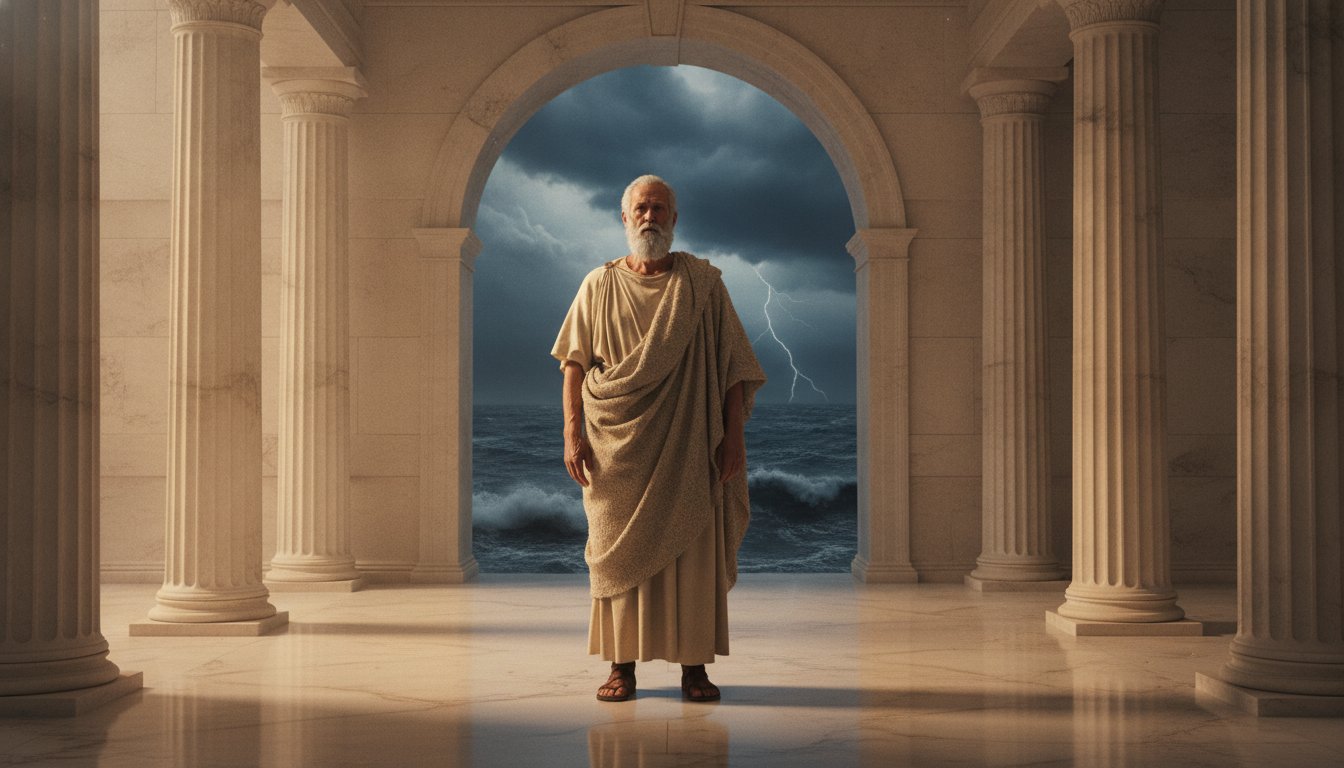
What if the frantic urgency of a crisis isn't a signal to move faster, but a command to stand still? You've felt the suffocating weight of a choice that must be made immediately. The mind clouds. The pulse quickens. External demands pile up. It's easy to feel paralyzed by this noise or, worse, to let a sudden surge of fear dictate a choice you'll regret by morning. This struggle with decision making under pressure is a fundamental test of the human character.
You don't have to be a victim of the moment. You'll learn how to maintain clarity and act with virtue when the stakes are highest by applying timeless Stoic principles of disciplined judgment. We'll provide a structured framework for clear thinking and emotional stability during chaos. By refining your internal perception, you can ensure your final path is forged by reason and aligned with your values rather than dictated by fleeting impulses. Let's begin the work of building your inner citadel.
Key Takeaways
- Interrogate your initial impressions. Look at how the mind adds layers of distress to objective events to regain your composure.
- Apply the dichotomy of control. Shed the burden of external results and focus your energy solely on your internal agency.
- Refine your decision making under pressure. Employ the rigorous logic of the Academy of Practical Wisdom to separate objective fact from personal narrative.
- Evaluate every choice through the lens of the four Stoic virtues. Prioritize the development of character over the pursuit of immediate, fleeting outcomes.
Table of Contents
- Understanding the "Impression": How Pressure Distorts Our Reality
- The Dichotomy of Control: Filtering the Essential from the External
- Fact vs. Interpretation: The Academy of Practical Wisdom Approach
- Acting with Virtue: Making Decisions that Build Character
Understanding the "Impression": How Pressure Distorts Our Reality
Pressure is an internal phenomenon. It doesn't exist in the external world; it resides in the mind's interpretation of a situation. The Stoics identified the initial mental image we receive as phantasia, or an impression. In moments of crisis, these impressions arrive with a violent intensity. They demand immediate action and carry the heavy weight of fear. Effective decision making under pressure requires you to recognize that the "pressure" is merely a layer of judgment you've added to the facts. Clear judgment is the ability to see things as they are, without the coloring of fear.
The Anatomy of a High-Stakes Impression
Distinguish between raw data and the narrative you construct. A missed deadline is a fact. The idea that "my career is over" is a story. Marcus Aurelius maintained his composure by practicing objective representation. He described fine Falernian wine as merely fermented grape juice and royal purple robes as sheep’s wool dyed with the blood of a shellfish. Use this same precision. Strip away the emotional labels. When you remove the adjectives of "disastrous" or "terrifying," you're left with a manageable reality that you can navigate with logic.
Withholding Assent: The First Line of Defense
Do not let the mind run away with a false impression. The Stoics taught the importance of synkatathesis, or assent. Just because a thought enters your mind doesn't mean you must accept it as true. Practice the brief, disciplined pause. In that silence, interrogate the urgency. Ask yourself a simple question: "Is this impression helpful or true?" If the answer is no, refuse to give it your assent. This mental distance is the foundation of the work within the Academy of Practical Wisdom. By withholding your agreement, you preserve your internal freedom and prevent the chaos from taking root in your character.
The Dichotomy of Control: Filtering the Essential from the External
Epictetus offered a fundamental rule that serves as the ultimate filter for the mind. Some things are up to us. Some are not. Most distress in decision making under pressure arises when we ignore this boundary. We exhaust our mental energy trying to manipulate variables like "what others think" or the "final result." These are external factors. They're indifferent to your anxiety. When you focus on what you can't influence, you invite paralysis.
To regain clarity, you must categorize every input before you act. Use a simple framework to divide your thoughts:
- Controllable: Your present judgment, your intent, and the integrity of your effort.
- External: Market shifts, competitor reactions, and the ultimate outcome of the choice.
By isolating what's within your power, you strip away the layers of unnecessary burden. This disciplined judgment is a core practice within the Academy of Practical Wisdom. It transforms a chaotic moment into a series of manageable tasks.
Focusing the Will on the Internal
Direct your will toward your own effort and integrity. This shift reduces the physiological weight of pressure because your success no longer depends on a fickle world. The Stoics utilized the "Reserve Clause," known as hupexhairesis. It's a way of planning for a specific goal while acknowledging that external interference is possible. You aim for the target with total focus, but your character is defined by the quality of your aim rather than the impact on the target.
Relinquishing the Noise
Identify the external noise that clutters your process. If you can't change a factor in this immediate moment, it's noise. There's a profound relief found in accepting what can't be changed. It creates the mental space needed for excellence. Mastering decision making under pressure requires you to prune the non-essential until only the path of virtue remains. To stay grounded in these principles, you might Cultivate Wisdom through daily reflection and methodical study.
Fact vs. Interpretation: The Academy of Practical Wisdom Approach
Stoic logic provides the architectural strength needed for decision making under pressure. It's not enough to simply feel calm. You must ensure your reasoning is sound. The Academy of Practical Wisdom teaches a rigorous audit of the internal monologue. Most errors in judgment occur when we blur the line between objective fact and subjective interpretation. A fact is a neutral event. An interpretation is the value judgment you assign to it. Effective decision making under pressure requires a commitment to fact over fiction.
The Logic of Sound Judgment
Strip away the emotional weight. Move from the thought "this is a catastrophe" to the realization "this is a set of circumstances that requires a response." Under stress, the mind often falls into the trap of catastrophizing. This is a logical fallacy. It assumes a single failure will lead to total ruin. Identify these breaks in your logic. Look for the soundness of your premises. If the foundation of your thought is a fear-based exaggeration, the resulting decision will be unstable.
Reflective Action in Real Time
Engage the world without losing yourself. Maintaining your "Inner Citadel" allows you to act externally while remaining undisturbed internally. This isn't passivity. It's disciplined action. It's the difference between a reactive impulse and a reflective choice. To sharpen this ability, you must Cultivate Wisdom through consistent, daily practice. Refuse to be moved by the frantic energy of others.
Reflect on your choices after the storm has passed. Use the Stoic Journal to dissect your previous reasoning. Ask: "Where did my interpretation deviate from the truth?" This post-decision analysis builds the mental muscle required for future crises. It ensures that your character remains the primary architect of your life. It's a continuous process of refinement.
Join the Journey## Acting with Virtue: Making Decisions that Build Character
The world judges a decision by its results. If a gamble pays off, it's called genius. If it fails, it's called folly. This is a shallow metric. True excellence in decision making under pressure requires a shift in focus. You must judge the quality of your choice not by the outcome, which you cannot control, but by the virtue displayed in the moment of crisis. A decision made with integrity is a success, even if the external consequences are difficult. It's the difference between the root and the fruit. To deepen your understanding of this approach, Explore the Living Library and study the lives of those who prioritized character over convenience.
The Four Virtues as a Decision Matrix
Use the cardinal virtues as your compass. Before you act, interrogate your intent through these four lenses. Wisdom asks if you're seeing the whole picture or if your vision is narrowed by fear. Courage demands to know if you're doing what's right despite the personal cost. Justice weighs whether the choice is fair to everyone involved or if it serves only your immediate interests. Temperance checks if you're acting with restraint or if you're being swept away by excess and urgency. This matrix transforms decision making under pressure from a gamble into a deliberate act of self-refinement. It ensures every choice strengthens your internal foundation.
Finding Inner Freedom Through Responsibility
Take full responsibility for your choices. This is where you find true agency. When you stop blaming external factors, you reclaim your power. You're no longer a leaf in the wind. You're the architect of your own response. This responsibility isn't a burden; it's the path to inner freedom. View every high-stakes moment as the ultimate training ground for the soul. Each choice is an opportunity to prove your character. Refine your judgment. Act with virtue. Find your peace. This is the serious pursuit of internal development. It's the work of a lifetime. Find Inner Freedom.
Forge Your Inner Citadel
Refining your judgment is a lifelong discipline. You've explored how to strip away the distortion of fear by separating raw facts from emotional impressions. By applying the dichotomy of control, you can focus your limited energy on what truly matters: your own intent and integrity. Decision making under pressure becomes a transformative exercise when you view every crisis as a chance to practice wisdom, courage, justice, and temperance. These principles don't just solve immediate problems. They build a character that remains unshaken by external storms.
You can access the Academy of Practical Wisdom for structured learning or explore the Living Library to connect these virtues to modern leadership. The path to mental fortitude is open. It requires only your consistent commitment to see things as they are. Every high-stakes moment is an invitation to prove your philosophy. Stand firm in your reason and act with clarity.
Join the Journey## Frequently Asked Questions
How does Stoicism help with decision-making in a fast-paced environment?
Stoicism provides a mental filter to separate objective reality from emotional noise. In rapid situations, it allows you to withhold assent to panic. By focusing on the logos, the rational order of things, you can act with precision rather than reacting to speed. It's about maintaining an internal stillness that doesn't mirror the external chaos. This discipline ensures that your choices remain grounded in reason and character.
What is the "Dichotomy of Control" and how do I apply it under pressure?
The dichotomy of control is the practice of distinguishing what is up to us from what is not. Under pressure, you apply it by discarding concerns about outcomes, such as market results or public opinion. Focus exclusively on your own judgment and actions. This narrowing of scope clarifies decision making under pressure by removing the weight of variables you cannot influence. It restores your agency and focus in the present moment.
Can Stoic exercises actually reduce the physical feeling of stress during a crisis?
Stoic practices address the cognitive source of physical stress. While we don't offer medical advice, the philosophy teaches that your physiological reaction often stems from your judgment of an event as harmful. By reclassifying an event as an indifferent external, you may find the body's fight-or-flight response naturally subsides. It's a process of using logic to reassure the mind that the internal self remains safe from external harm.
Is Stoic decision-making about being indifferent to the results of my choices?
It's about being unattached to the result while being fully committed to the process. You prefer a positive outcome, but you recognize that it's an indifferent factor outside your absolute control. Your primary goal is to act with virtue. If you act with wisdom and justice, the decision is a success regardless of the end result. This perspective allows for courageous decision making under pressure without the paralyzing fear of failure.
How can a digital journal improve my ability to make decisions in the future?
A digital journal serves as a repository for your internal reasoning. It allows you to conduct a post-mortem on your choices once the pressure has dissipated. By reviewing your past impressions and judgments, you can identify recurring logical fallacies or emotional triggers. This practice of constant observation turns every experience into a lesson. It refines your character and builds the mental structure needed for even more complex challenges in the future.
Ed Korporaal
Founder, StoicOs.ai