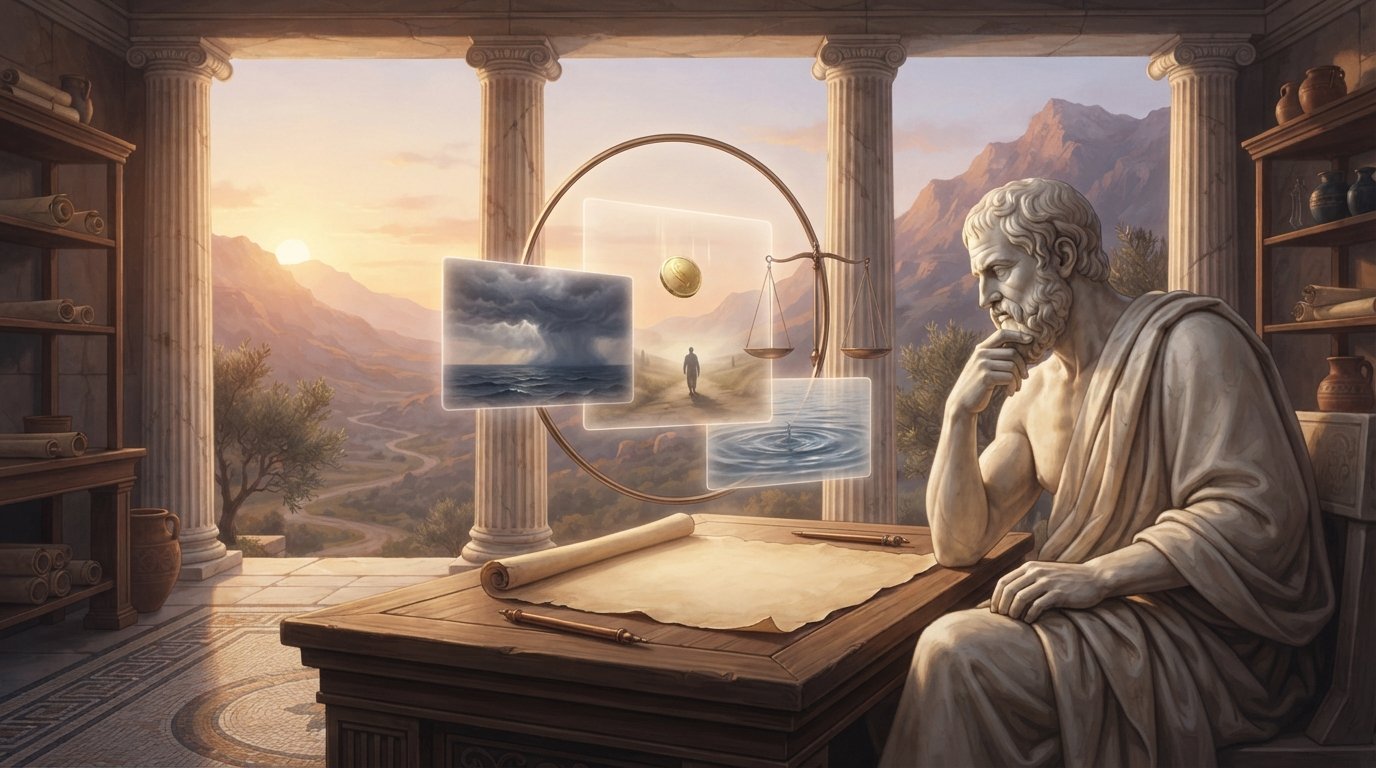
What if the world you perceive is not a series of facts, but a sequence of raw proposals? Most of us move through life as if our feelings are direct reflections of reality. We feel the sting of an insult or the weight of a deadline and accept them as objective truths. You likely find yourself overwhelmed by these reactive emotions. It's a common burden. To find clarity, you must first ask: what are impressions in Stoicism? The ancient Greeks called this phantasia. It is the initial presentation of an external event to your mind before your reason begins its work.
Mastering your response to these mental images leads to a profound sense of inner freedom. This guide defines the Stoic cognitive model and the essential discipline of assent. You'll learn to pause before you react. We'll bridge the gap between ancient logic and your modern experience. Prepare to build a more resilient character through the deliberate refinement of your judgment. The path to a disciplined mind starts with seeing things as they truly are.
Key Takeaways
- Define the raw presentation. Understanding what are impressions in Stoicism reveals that your initial perceptions are merely proposals, not final truths.
- Recognize your internal authority. You possess the sovereign power to grant or withhold assent to any thought that enters your mind.
- Distinguish between deceptive appearances and kataleptic impressions. Learn to identify those clear presentations that offer a firm, reliable grip on reality.
- Master the art of stripping away. Apply practical exercises to isolate objective facts from the subjective value judgments that often cloud your reason.
Table of Contents
- Defining the Stoic Impression: The Concept of Phantasia
- The Mechanics of Mind: From Impression to Assent (Synkatathesis)
- Distinguishing Truth: The Kataleptic Impression
- Practical Wisdom: Disciplining Your Impressions in Modern Life
Defining the Stoic Impression: The Concept of Phantasia
Observe the mind. It is a vessel. Every sensation is a visitor. These presentations are what we call impressions. Phantasia is the raw material of thought before judgment is applied. It is a proposal. A mental image. When seeking to understand what are impressions in Stoicism, look to the threshold of your own awareness. It's the space where the external world meets your internal faculty. It's the first spark of consciousness.
Zeno of Citium, a pillar of Stoic philosophy, described this as a printing on the soul. He used the term tupōsis. It suggests a physical impact. Like a seal pressed into warm wax, the world leaves its mark on your perception (SVF 1.58). Every impression carries a lekton. This is the "sayable." It's the silent proposition the mind attaches to the raw data. It's the bridge between a physical sensation and a conscious thought.
Ancient Sources and the StoicOs Translation
Early records clarify this structure. Diogenes Laertius and Aetius documented how the Stoa categorized these mental events. They viewed the mind as a blank slate, ready for the world’s inscription. This was a serious pursuit of logic. Master the logic, and you master the man.
StoicOs Translation: "An appearance is an affection occurring in the soul, revealing both itself and the cause that produced it."
This fragment reminds us that an impression is a mirror. It shows the object. It also shows the quality of the glass. The Academy of Practical Wisdom focuses on cleaning that glass through the study of logic.
Why Impressions Are Not Yet Judgments
Appearances are involuntary. You don't choose to hear the wind. You don't choose to see the light. These events are forced upon the senses. They are not yet judgments. An impression merely states, "this person is speaking loudly." A judgment adds, "this person is being rude." The first is a neutral report. The second is an interpretation. By separating the two, you begin the work of refinement. You move from a reactive state to one of grounded observation. This is the discipline of the wise. It requires patience. It demands a quiet soul.
The Mechanics of Mind: From Impression to Assent (Synkatathesis)
The mind does not merely receive; it evaluates. Once an appearance strikes the soul, the governing faculty, or hegemonikon, must decide its validity. This is the stage of synkatathesis. It is the internal "yes" or "no" we give to the truth of what we see. As detailed in the Stanford Encyclopedia of Philosophy's entry on Stoicism, this process is central to their theory of knowledge. You aren't a slave to your first thoughts. You are the judge of them. By using logos, or reason, you determine if a presentation is reliable.
The silent interval between the arrival of an impression and the movement of assent is the true seat of human freedom. In this gap, reason exerts its power. If you rush to agree with a deceptive presentation, you surrender your autonomy. To master what are impressions in Stoicism, you must learn to hold them at a distance. Examine them. Don't let them pass the gates of your mind without a challenge. This discipline transforms a reactive life into a proactive one.
The Three Steps of Disciplined Judgment
- Receive: Observe the impression as raw data without immediate emotional reaction.
- Test: Ask if this presentation concerns things within your control or external to your will.
- Assent: Grant your agreement only if the impression aligns with reality and virtue.
When the Mind Errs: The Path to Passion
A passion is not a random surge of emotion. It's a judgment gone wrong. When you assent to a false impression, such as the belief that an external loss is a true evil, you create a pathos. This leads to internal distress. To refine this faculty, consider the Academy of Practical Wisdom course on clear thinking. It provides the tools to audit your internal dialogue. You can also Join the Journey to receive weekly insights on maintaining mental fortitude through disciplined logic.
Distinguishing Truth: The Kataleptic Impression
Not all presentations are equal. Some are blurred. Some are sharp. The Stoics identified the kataleptikē phantasia as the criterion of truth. This is a grasping impression. It is so clear and distinct that it compels the mind to agree. To understand what are impressions in Stoicism, one must recognize this hierarchy of clarity. A true impression arises from what exists. It's in accordance with that existence. It leaves no room for doubt. It is the bedrock of certain knowledge. As noted in the Stanford Encyclopedia of Philosophy's entry on Stoicism, this "grasping" is what separates the sage from the fool. The fool assents to shadows. The sage waits for the light.
The Wise Person and the Withholding of Assent
Clarity is often absent. When an appearance is muddled, the disciplined mind practices epochē. This is the suspension of judgment. It's a refusal to say "yes" to a half-truth. Epictetus offered a vital command for these moments. He told us to say: "wait for me a little, impression; let me see who you are and what you represent" (Discourses 2.18.24). This pause prevents the soul from being swept away by false alarms. It is the practice of withholding assent until the data is undeniable. You don't have to have an opinion on everything. Silence is a form of strength.
Applying Grasping Impressions to Modern Decisions
Noise surrounds us. Digital platforms and emotional triggers create a fog of non-kataleptic impressions. In a world of digital noise, understanding what are impressions in Stoicism allows you to filter out the static. You must strip away the interpretation to find the fact. Is the event truly a catastrophe, or is that just the "sayable" attached to it? Discerning truth requires a systematic audit of your perceptions. You can explore the Living Library for guided journeys on this very path. Refine your vision. See the world as it is, not as your fears describe it.
Cultivate Wisdom## Practical Wisdom: Disciplining Your Impressions in Modern Life
Philosophy is a craft. It's the art of living well. Master the tools. To truly grasp what are impressions in Stoicism, you must move beyond the library and into the arena of daily action. Theory provides the map, but practice is the journey. Your character is not a fixed monument. It's a living structure built by the cumulative quality of your assents. Every time you refuse a false impression, you strengthen the foundation of your inner freedom. This is the work of a lifetime.
Modern tools aid this ancient pursuit. Using The Stoic Journal allows you to audit the presentations that move through your mind. It's a space for deliberate inspection. Similarly, the Virtue Guide provides a framework for AI-assisted reflection. It helps you determine if a particular impression aligns with the four cardinal virtues. This isn't about productivity. It's about the serious pursuit of wisdom. Refine your judgment. Build your soul.
The 'Strip it Bare' Exercise
Marcus Aurelius practiced a technique of physical definition. He stripped objects of their legends. He described fine wine as merely fermented grape juice. You can apply this today. When a situation feels heavy, describe it in purely objective language. Reframing "I was insulted" to "That person spoke certain words" removes the sting. The data is neutral. You remove the "sayable" that causes distress. This leaves you with a neutral event that reason can handle with composure.
Evening Audit of Assent
Reflection is the final step in the discipline of the mind. Before sleep, look back at your day. Identify which impressions you accepted too quickly. Did you assent to anger? Did you agree with a deceptive fear? By reviewing these moments, you prepare the mind for the next day's challenges. The Crucial Stoic Practice](https://stoicos.ai/stoic-journal) to deepen this habit. Consistency is the key to transformation. Small, daily corrections lead to a life of profound mental clarity.
The Path to Mental Sovereignty
The architecture of a resilient soul begins with the scrutiny of every thought. You've examined the nature of raw presentations and the sovereign power of the mind to grant or withhold assent. Understanding what are impressions in Stoicism is the first step toward this mental sovereignty. It transforms the chaotic noise of the world into a series of logical inquiries. By isolating the objective fact from the added judgment, you secure your inner freedom against external turbulence.
Refinement is a methodical process. The AI-powered assists your daily reflection, while the curated Living Library preserves the weight of ancient experience. These resources support your growth in the Academy of Practical Wisdom, where disciplined logic becomes a practical habit. You possess the capacity for profound internal development.
Enter the Academy of Practical WisdomWalk with intention. The journey toward wisdom is a serious pursuit, yet it's the only path that leads to a truly stable character.
Frequently Asked Questions
What is the difference between an impression and a thought in Stoicism?
An impression, or phantasia, is the raw presentation of an object to the mind. A thought is often the result of the mind's internal processing or assent. In this framework, an impression is the initial data. Thoughts involve the lekton, or the underlying proposition that the mind evaluates. Understanding what are impressions in Stoicism requires recognizing them as the involuntary first stage of your daily cognitive process.
Can we control our impressions according to Epictetus?
You cannot control the initial arrival of an impression, but you have absolute authority over your response. Epictetus taught that while appearances are forced upon us by the environment, the "use of impressions" is entirely within our power. You don't choose what you see. You choose whether to accept the value judgments attached to those raw sensory inputs. Character is built by this intentional and disciplined selection.
What does it mean to withhold assent from an impression?
Withholding assent means refusing to agree that a particular impression is true or that its attached judgment is correct. This practice, known as epochē, involves pausing when an appearance is unclear. It's a state of suspended judgment. By not saying "yes" to a muddled presentation, you protect your reason from error. This prevents the formation of irrational passions and maintains your internal stability during stressful events.
How do Stoic impressions relate to modern cognitive behavioral therapy (CBT)?
Stoic impressions are the philosophical ancestors of the "automatic thoughts" identified in modern cognitive behavioral therapy. Both systems suggest that our distress stems not from events, but from our interpretations. While CBT focuses on psychological health, the Stoic model is a broader logic of judgment. Refining your response to what are impressions in Stoicism is a core practice in the Academy of Practical Wisdom to achieve lasting inner freedom.
Is a 'kataleptic impression' the same as an objective fact?
A kataleptic impression is a presentation so clear that it "grasps" the mind, making it impossible to doubt its truth. It arises from what is and is in accordance with what is. While it functions like an objective fact, it's technically a psychological state of certainty. It serves as the Stoic criterion of truth. This provides a firm foundation for all subsequent rational actions and decisions in your life.
Ed Korporaal
Founder, StoicOs.ai
