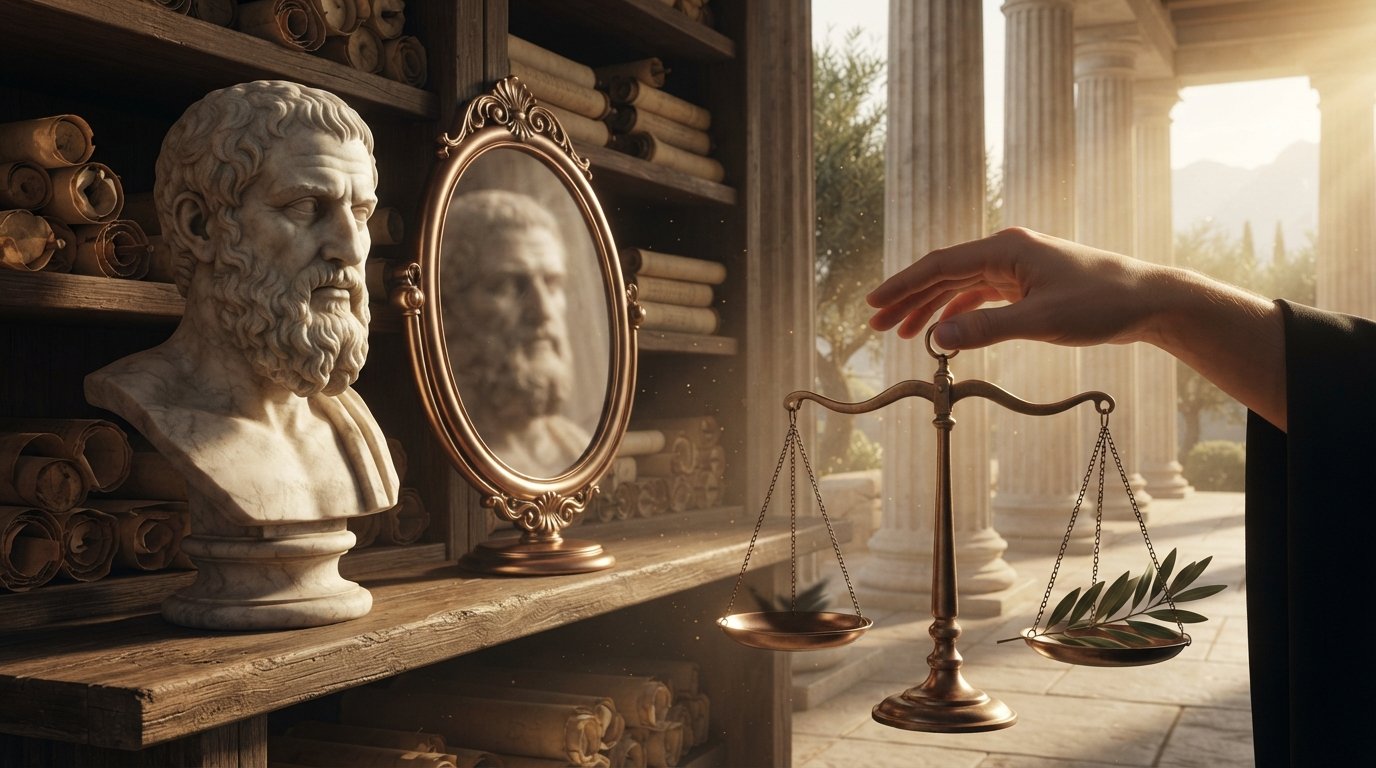
Could you be making a profound error in the time it takes to blink? Research suggests that within just 100 milliseconds, your mind has already finalized a judgment on someone's trustworthiness and competence. It's a sobering reality that first impressions are often wrong, yet we treat these flashes of intuition as objective truths. You likely know the weight of this error. You feel the friction of a misunderstood colleague. You carry the regret of a decision made in haste. In our digital age, the pressure to judge quickly is relentless.
This article examines the Stoic understanding of phantasia, the initial impression that strikes the mind. We will explore the vital necessity of synkatathesis, or rational assent. By learning to pause before we agree with our own perceptions, we move beyond reactive bias. Observe your thoughts. Refine your faculty of judgment. We will discover how the discipline of the Stoa transforms involuntary first movements into a foundation for refined leadership and inner freedom.
Key Takeaways
- Identify the biological shortcuts that prioritize rapid assessment over objective truth. Understand the evolutionary mechanisms that explain why first impressions are often wrong.
- Distinguish between the unbidden mental impression, known as phantasia, and the deliberate act of rational assent. Treat initial perceptions as raw data rather than final judgments.
- Employ the discipline of intentional delay in professional settings. Practice describing your interactions through objective observation to remove the distortion of emotive bias.
- Strengthen your character by grounding the four cardinal virtues in refined judgment. Learn how the practice of suspending assent leads to profound emotional clarity and inner freedom.
Table of Contents
- The Psychology and Biology of Why First Impressions Are Often Wrong
- The Stoic Mechanism: Phantasia and the Power of Assent
- Practical Exercises to Refine Your Judgment
- Cultivating Wisdom: Beyond the Surface Level
The Psychology and Biology of Why First Impressions Are Often Wrong
Our biology prioritizes speed over precision. For our ancestors, a delayed judgment was often a fatal one. They required immediate categorization of strangers as either threat or ally. This ancient necessity birthed a cognitive shortcut where accuracy is sacrificed for rapid response. We must accept that first impressions are often wrong because they're designed for survival, not for the pursuit of truth. It's a relic of a primitive era that often clashes with the demands of modern character. Our brains haven't yet caught up to the complexities of the digital social landscape.
Evidence of this hard-wiring appears early in development. Research into "Face Value" judgments shows that infants as young as 11 months old already demonstrate biased crawling patterns toward faces they perceive as more trustworthy. These automatic reactions align with the Stoic concept of phantasiai. These are raw impressions that strike the mind before we have a chance to think. Stoics categorized these involuntary twitches as propatheiai, or pre-passions. They aren't yet moral errors; they're simply biological events that require our disciplined attention.
The Speed of Misjudgment
Science confirms that we form trait evaluations in as little as 100 milliseconds. Subcortical structures like the amygdala react to social cues before the conscious mind can engage. This rapid processing frequently leads to the Halo Effect. The Halo Effect is a cognitive error where our perception of one positive quality leads us to assume the presence of other unrelated virtuous traits. We see beauty and assume wisdom. We see confidence and assume competence. These are flaws in our architectural judgment that we must learn to correct through practice.
Survival Instinct vs. Rational Virtue
The primitive brain seeks safety. The Stoic seeks truth. While "gut feelings" are often praised, they're frequently just echoes of previous biases rather than genuine intuition. To grow, we must move beyond these survival-based echoes. We must subject every impression to the light of reason. Those who wish to refine their faculty of judgment can find structure in the Academy of Practical Wisdom, where logic serves as a shield against these ancient, flawed impulses.
The Stoic Mechanism: Phantasia and the Power of Assent
To the Stoic, an impression, or phantasia, is merely a presentation of data. It's the raw image of a face or the tone of a voice before the mind labels it. We must acknowledge that first impressions are often wrong, yet the ancient Stoa offered a psychological barrier against this error. They called it synkatathesis, or the power of assent. This is the voluntary act of granting your agreement to an appearance. Until you give assent, the impression remains outside your character. It has no power to deceive you.
Fact vs. Interpretation in Stoic Logic
The Academy of Practical Wisdom emphasizes the rigorous stripping away of value judgments. We must distinguish between the physical fact and our narrative of it. Modern research in social psychology confirms that rapid judgments of character are frequently inaccurate, reflecting bias over reality. Consider this StoicOs Translation of a fragment from Epictetus (Enchiridion 1.5): "Do not be swept away by the intensity of the impression. Say to it: 'Wait for me a little. Let me see what you are and what you represent. Let me test you.'" This testing prevents the friction caused when first impressions are often wrong. It ensures that we respond to the world as it is, not as we fear it might be.
The Discipline of the Mind
Marcus Aurelius frequently returned to the idea of the Inner Citadel. This is the mental space where your governing faculty, the hegemonikon, remains untouched by external chaos. By practicing prosochē, or constant mindfulness, you catch impressions at the gate. You become the sentry of your own mind. You don't have to believe everything you think. This internal sovereignty is the foundation of all virtue. To deepen this mental fortitude, you might choose to Join the Journey through our weekly reflections. Refined judgment is not a gift; it's a discipline of the will.
Practical Exercises to Refine Your Judgment
Wisdom is not a theoretical pursuit; it's a daily labor of refinement. Because first impressions are often wrong, we must install practical filters between our perceptions and our actions. The 'Wait and See' technique is a primary tool for this purpose. In professional environments, commit to a 24-hour moratorium on judgments. Don't label a new colleague as difficult or a project as doomed based on a single meeting. Allow time for the initial biological surge to recede before you form a conclusion. This delay allows the governing faculty to regain its footing.
Practice objective description. When reflecting on an encounter, remove all emotive adjectives. Instead of noting a "hostile" tone, record that "the speaker's volume increased." This shift grounds you in reality rather than narrative. These exercises rely on the discipline of the mind, which teaches us to treat internal appearances as hypotheses rather than verdicts. Ask yourself: "Is this within my control?" and "Is this based on evidence or merely appearance?" By questioning the source, you strip the impression of its power to deceive.
The Pause of the Sage
Apply the "Stop, Breathe, Examine" method during social interactions. First, physically stop your movement. Second, breathe to steady the physiological startle response. Third, examine the impression. You can use the Virtue Guide to categorize these impressions as they arise. This practice creates the necessary space for reason to intervene before a reaction takes hold. It's a quiet act of rebellion against impulsive behavior.
Deconstructing the Impression
Try this exercise: "I saw a person with crossed arms and furrowed brows." This is the sensory fact. The judgment "they are angry with me" is an unvetted addition. To master this logical parsing, many enter the Academy of Practical Wisdom. Finally, audit your day using the Stoic Journal. Ask yourself where you granted assent too quickly. We must remember that first impressions are often wrong when they remain unexamined by the light of logic.
Cultivate Wisdom## Cultivating Wisdom: Beyond the Surface Level
Refined judgment serves as the essential bedrock of the four cardinal virtues. Without clear observation, wisdom becomes impossible. Courage requires a true assessment of what is genuinely harmful. Justice demands an unbiased view of our fellow humans. Temperance necessitates control over the initial twitches of desire or aversion. We recognize that first impressions are often wrong because they lack the structural depth required for these virtues. To live well, we must move beyond the surface and engage with the substance of character.
Building Character Through Responsibility
Stoicism teaches a vital distinction. We are not responsible for the unbidden movements of the mind. We are, however, entirely responsible for our assent. To accept a flawed impression as truth is a failure of character. It's a choice. By refining our faculty of judgment, we fulfill our duty to our own nature. The Living Library provides paths to deepen this understanding. It offers the historical and philosophical context needed to evaluate the internal states that govern our lives.
The Journey to Inner Freedom
True freedom is found in the space between stimulus and response. When you master your judgment, you are no longer a victim of cognitive bias or biological echoes. You become a strategist of your own soul. This transformation is the ultimate goal of our practice. You move from the frantic pace of reactive judging to the steady, architectural rhythm of proactive wisdom. StoicOs.ai stands as a repository for this serious inquiry into reality and character. It's a quiet invitation to self-improvement. Remember that first impressions are often wrong when they lack the filter of reason. Stop being led by appearances. Start being guided by the truth of your own character.
Master the Art of Refined Judgment
Biology demands survival through speed. Wisdom demands justice through truth. We must accept that first impressions are often wrong, but we don't have to remain their prisoners. You now possess a psychological framework to distinguish raw appearances from objective reality. By practicing the pause of the sage and withholding assent, you reclaim your inner freedom from the noise of digital social interactions and primitive biases. This is the work of a lifetime. It requires constant mindful attention. It requires a commitment to looking inward.
To support this development, enter the Academy of Practical Wisdom to master the rigors of Stoic logic. Use the for daily disciplined reflection on your proto-judgments. Explore the Living Library's curated journeys on Wisdom to anchor your modern decisions in historical strength. These tools from StoicOs.ai are designed for the serious pursuit of internal development.
Join the JourneyCharacter isn't a gift. It's an architectural structure built in the quiet moments of observation. Choose to see clearly. Live with the gravity of a master of judgment.
Frequently Asked Questions
What did Marcus Aurelius say about first impressions?
Marcus Aurelius taught that we should never be overwhelmed by the intensity of an appearance. He emphasized the "Inner Citadel," where our governing faculty remains separate from external chaos. In his reflections, he frequently reminds himself to strip away the narrative from the raw event. By removing these added value judgments, we protect our mental peace and maintain the clarity of our own character.
Can I ever trust my intuition if first impressions are often wrong?
You should treat intuition as a hypothesis rather than a final verdict. While snap judgments are a biological survival mechanism, first impressions are often wrong when they remain unexamined by reason. Stoicism encourages us to pause and test the evidence. By analyzing the impression before granting agreement, you transform a reactive "gut feeling" into a deliberate and virtuous choice grounded in objective reality.
How does Stoic logic help in identifying cognitive biases?
Stoic logic provides a structured framework for fact-vs-interpretation analysis. The Academy of Practical Wisdom offers a Logic course specifically designed to help practitioners identify flawed reasoning and cognitive shortcuts. By learning to recognize the gap between a sensory impression and a rational conclusion, you can see through biases like the Halo Effect. This discipline ensures your actions are based on truth rather than unvetted mental representations.
What is the difference between an impression and an assent in Stoicism?
An impression, or phantasia, is a passive mental representation presented to the mind. It's an involuntary biological event. Assent, known as synkatathesis, is the voluntary act of the rational mind accepting that impression as a true reflection of reality. Stoic practice focuses on the space between these two movements. Wisdom lies in withholding assent from any impression that has not been thoroughly tested by your governing faculty.
How can I practice Stoicism to improve my professional relationships?
Improve your professional life by practicing intentional delay before judging colleagues or clients. Use the for daily reflection on your initial perceptions. By auditing your day in the Stoic Journal, you can identify where first impressions are often wrong and caused interpersonal friction. This practice fosters character-based leadership. It allows you to respond with justice and temperance rather than reacting to unvetted biological biases.
Ed Korporaal
Founder, StoicOs.ai
