SVF I.66
- Stoic
- Zeno of Citium
- Ancient source
- Cicero, Academica Priora (Lucullus), Book II — Acad. pr. 2.144
- Source language
- Latin
- Source status
- Later report
Original — Latin
Et hoc quidem Zeno gestu conficiebat. Nam cum extensis digitis adversam manum ostenderat, „visum“ inquiebat „huiusmodi est“. Deinde cum paullum digitos contraxerat, „adsensus huiusmodi“. Tum cum plane compresserat pugnumque fecerat, comprehensionem illam esse dicebat: qua ex similitudine etiam nomen ei rei, quod antea non fuerat, κατάληψιν imposuit. Cum autem laevam manum admoverat et illum pugnum arte vehementerque compresserat, scientiam talem esse dicebat, cuius compotem nisi sapientem esse neminem.StoicOs Translation
And this Zeno used to demonstrate with a gesture. When he had shown his hand open, fingers extended, he would say: “An impression is like this.” Then, contracting the fingers a little: “Assent is like this.” When he had closed them fully and made a fist, he said that this was cognition — and from this comparison he gave the thing a name it had not had before: katalēpsis. But when he had brought his left hand over and gripped that fist tightly and forcefully, he said knowledge was of that kind — and that no one possesses it except the wise.
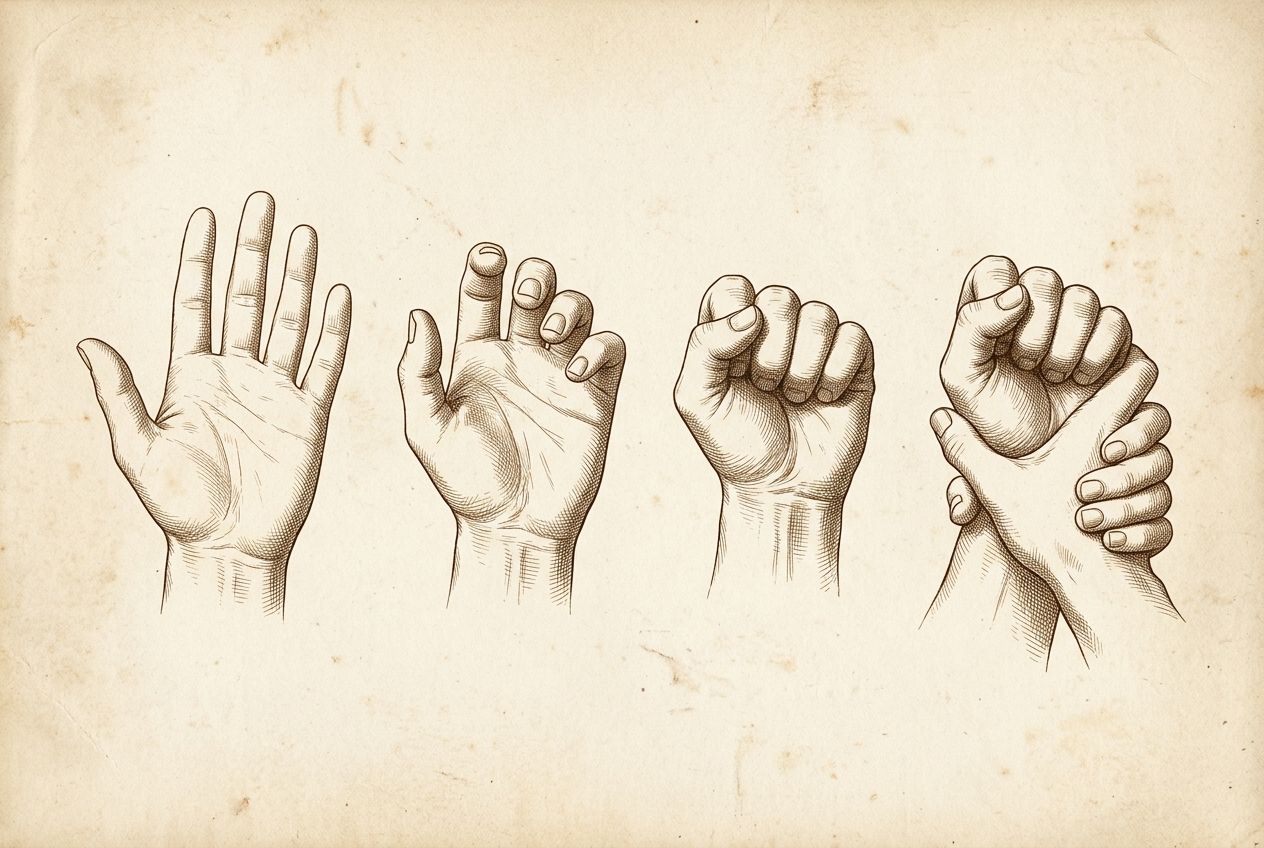
MODERN VISUALIZATION · TEXTUALLY ATTESTED
Zeno's four hand gestures — a reconstruction
Modern drawing made for StoicOs — no ancient image of this survives. From left to right, following Cicero's description in this fragment: the open palm (the impression), the slightly curled fingers (assent), the closed fist (the cognitive grasp, katalēpsis), and the fist enclosed by the other hand (knowledge, epistēmē).
- Dating
- Reconstruction: 2026; textual source: Cicero, 45 BCE
- Relation to Zeno
- Directly based on the gesture sequence Cicero attributes to Zeno in this very fragment (SVF I.66 = Academica priora 2.144–145).
- Identification
- The gestures are textually attested; the drawing itself is a modern interpretation and has no ancient pictorial source.
- Source
- Cicero, Academica priora 2.144–145 (SVF I.66)
- Image rights
- © StoicOs.ai — modern illustration, explicitly a reconstruction
Context
Cicero, writing about 250 years after Zeno, reports this famous scene in the Lucullus during the debate over whether certain knowledge is possible. The report is in Latin and at several removes, but it preserves a vivid teaching gesture and the claim that Zeno coined the term katalēpsis.
Source notes:Text verified against H. von Arnim, SVF I (1903), no. 66, pp. 19–20 (scanned pages). Von Arnim's apparatus notes the variant contraxerat (cod. Cantabr.) against contexerat/conxerat. The Greek word κατάληψιν stands embedded in Cicero's Latin.
What the source actually tells us
This is a later report of Zeno's teaching practice, not his own words: the quoted phrases are Cicero's Latin dramatisation. What the testimony secures is the four-stage scale — impression, assent, cognition, knowledge — and Zeno's coining of katalēpsis; the exact wording of Zeno's Greek lessons cannot be recovered from it.
Philosophical meaning
The open hand, the curling fingers, the fist, the gripping left hand: no ancient image explains Stoic epistemology better. Knowing is presented as a progressive act of the mind — receiving, assenting, grasping, holding fast — with full knowledge reserved for the sage.
Go deeper
About this edition
StoicOs Ancient Library is a developing multilingual digital study edition of surviving early Stoic material. The Stoicorum Veterum Fragmenta assembled by Hans von Arnim provides the traditional reference framework. StoicOs distinguishes carefully between fragments, testimonia, later reports and interpretation. StoicOs translations are prepared from the surviving ancient-language sources where available.