SVF Volume I
Zeno of Citium
Ζήνων ὁ Κιτιεύς · c. 334–262 BCE
Who was Zeno of Citium?
Zeno (c. 334–262 BCE) came from Citium on Cyprus to Athens, studied with the Cynic Crates and in other Socratic schools, and around 300 BCE began teaching in the Stoa Poikile — the Painted Porch — from which Stoicism takes its name. He divided philosophy into logic, physics and ethics, and taught that virtue, lived in agreement with reason, is the substance of a good life.
Why most of his writings have been lost
Ancient catalogues credit Zeno with many works — including the famous Republic — yet none survives as a complete book. Papyrus rolls perished, libraries burned, and later antiquity copied the Stoics it read most: Chrysippus's systematic treatises and, later, Roman Stoics such as Seneca, Epictetus and Marcus Aurelius. Zeno's own words reach us only where later authors chose to quote, summarise or argue with him.
Fragment, testimonium — and why the difference matters
A fragment preserves (or claims to preserve) the philosopher's own wording, usually as a quotation inside a later work. A testimonium is a later author's report about what the philosopher taught, in the reporter's own words. A quotation gives us wording; a testimonium gives us doctrine as someone else understood it. The StoicOs edition labels every entry accordingly and never presents a report as if it were Zeno's own voice.
What SVF numbering means — and reading later sources critically
“SVF I.179” refers to item 179 of von Arnim's first volume — a modern catalogue number, not a chapter of Zeno. The preserving authors write centuries after Zeno, with their own aims: doxographers compress, critics distort, admirers harmonise. Later Stoic doctrine may illuminate a passage but must not automatically be projected back onto Zeno. Every StoicOs entry therefore weighs who reports, from what distance, and with what interest.
Vita · SVF I.1–46
The Life of Zeno — the ancient testimonia as one continuous account
Material Evidence
Authentic objects and archaeological sites connected to Zeno and his school. Each image carries its provenance; ancient evidence and modern reconstructions are always distinguished.
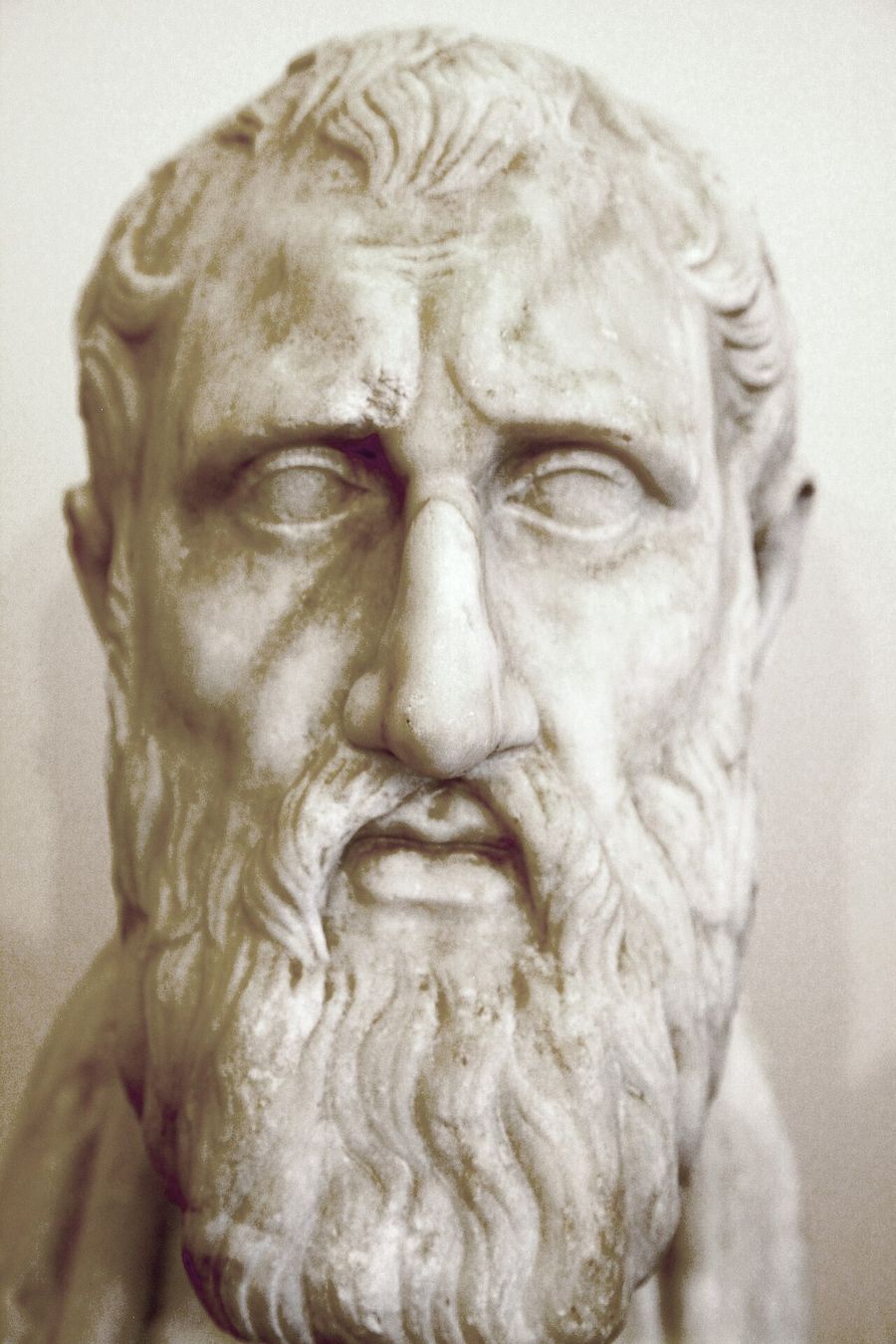
ANCIENT PORTRAIT TYPE · IDENTIFIED AS ZENO
Herm portrait of Zeno of Citium
Roman marble copy after a Hellenistic portrait type of the early 3rd century BCE — not a portrait made in Zeno's own lifetime. The lean, furrowed features became the standard image of the Stoa's founder in antiquity.
- Dating
- Roman copy; portrait type created early 3rd century BCE
- Findspot
- Findspot unrecorded; formerly Farnese Collection, Rome
- Collection
- Museo Archeologico Nazionale, Naples (Farnese Collection)
- Inventory no.
- inv. 6128
- Relation to Zeno
- The portrait type identified in scholarship as Zeno of Citium, founder of the Stoic school.
- Identification
- High — the identification of the type rests on inscribed herm copies and is generally accepted in scholarship.
- Source
- Museo Archeologico Nazionale di Napoli; photograph via Wikimedia Commons
- Image rights
- Photo: Jeremy Weate, CC BY 2.0 (Wikimedia Commons)
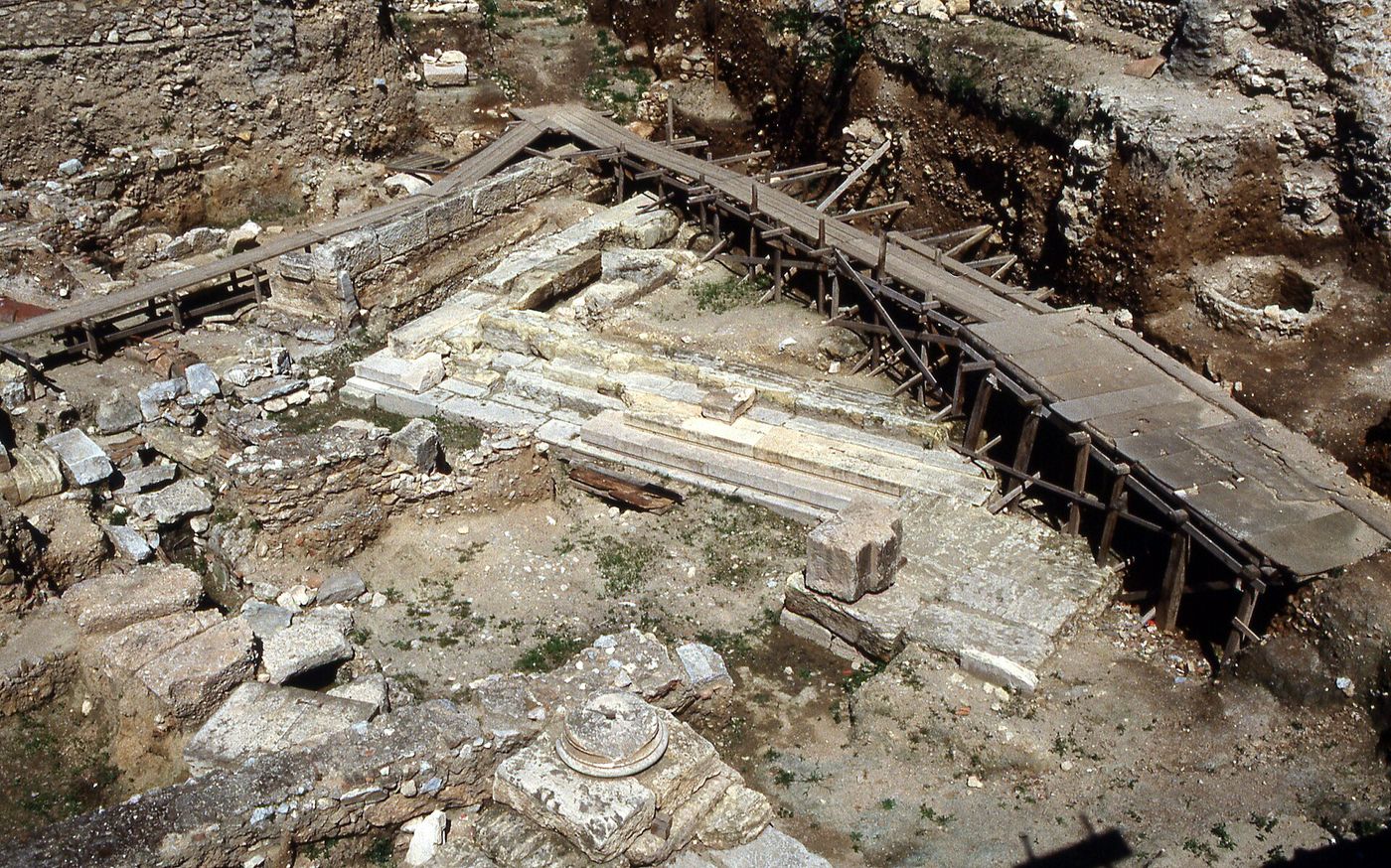
ARCHAEOLOGICAL SITE
The Stoa Poikile (Painted Stoa), west end
Excavated remains — not a modern reconstruction — of the colonnade on the north side of the Athenian Agora in which Zeno taught. The Stoic school takes its name from this building.
- Dating
- Building: c. 475–450 BCE; photograph: 1991
- Findspot
- Athens, Agora excavations north of Adrianou Street
- Collection
- In situ, Athenian Agora, Athens
- Relation to Zeno
- Zeno lectured in this stoa (Diogenes Laërtius 7.5); his followers were therefore called Stoics.
- Identification
- High — the identification of these remains as the Stoa Poikile is established by the Agora excavations.
- Source
- American School of Classical Studies at Athens, Agora Excavations; photograph via Wikimedia Commons
- Image rights
- Photo: Mark Landon, 1991, CC BY 4.0 (Wikimedia Commons)
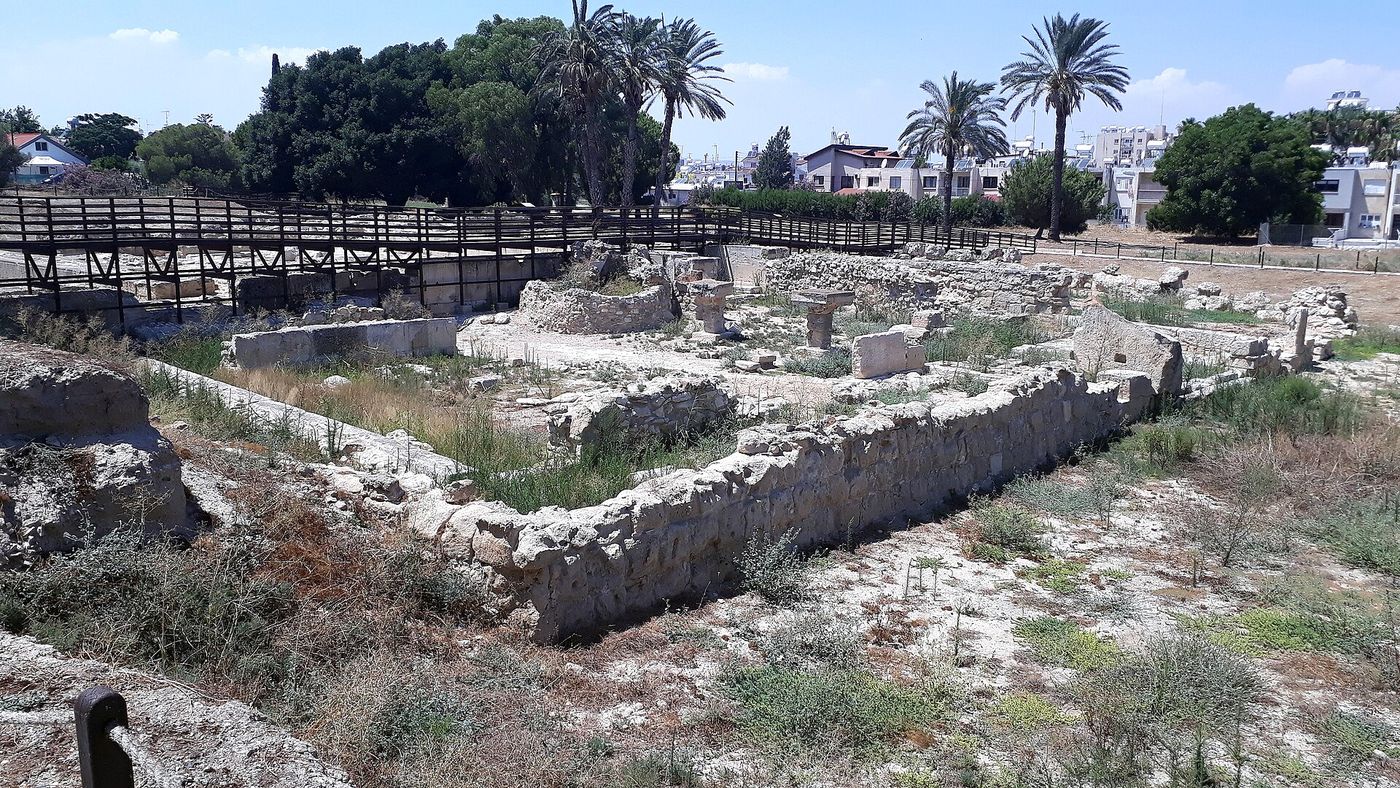
ARCHAEOLOGICAL SITE
Excavations of ancient Kition (Larnaca, Cyprus)
The archaeological area of Kition, the Cypriot harbour city where Zeno was born around 334 BCE — shown here as geographical and biographical context. No excavated structure or object can be connected to Zeno personally.
- Dating
- City occupied from the 13th century BCE; photograph: modern
- Findspot
- Kition archaeological site, Larnaca, Cyprus
- Collection
- In situ, Department of Antiquities, Cyprus
- Relation to Zeno
- Zeno's birthplace; from Kition he came to Athens around 312 BCE (Diogenes Laërtius 7.1–5).
- Identification
- High for the site itself — the identification as ancient Kition is archaeologically secure. No direct link to Zeno personally is claimed.
- Source
- Department of Antiquities, Cyprus; photograph via Wikimedia Commons
- Image rights
- Photo: Josef Moser, CC BY-SA 4.0 (Wikimedia Commons)
Source entries
76 / 76 sources
- SVF I.51Arrian (Epictetus) · Ancient GreekLater report
The theorems of the philosopher ... which Zeno states: to know the elements of reason (logos), what sort of thing each of them is, how they fit together with one another, and all that follows from them.
Read the source →
- SVF I.59Cicero · LatinLater report · Paraphrase by ancient source
An impression stamped and moulded from that which is, of such a kind as it could not be from that which is not.
Read the source →
- SVF I.60Cicero · LatinLater report
Not to all impressions did he (Zeno) attach trust, but only to those which carry a distinctive disclosure of the things seen; such an impression, when discerned in and by itself, he called graspable — (will you bear this word? We shall indeed, I said; for how else would you render katalēpton?) — but once received and approved, he called it a grasp (comprehensio), like things grasped by the hand; from this he drew the very name, no one having used that word for such a matter before, and he used many new words besides (for he said new things). What was grasped by sense he called a sensation, and if it was so grasped that it could not be dislodged by reasoning, he called it knowledge; otherwise, ignorance — from which arises also opinion, which is weak and shares in what is false and unknown. — But between knowledge and ignorance he placed that grasp of which I spoke, counting it neither among the right nor among the wrong, and said that it alone is to be trusted.
Read the source →
- SVF I.66Cicero · LatinLater report
And this Zeno used to demonstrate with a gesture. When he had shown his hand open, fingers extended, he would say: “An impression is like this.” Then, contracting the fingers a little: “Assent is like this.” When he had closed them fully and made a fist, he said that this was cognition — and from this comparison he gave the thing a name it had not had before: katalēpsis. But when he had brought his left hand over and gripped that fist tightly and forcefully, he said knowledge was of that kind — and that no one possesses it except the wise.
Read the source →
- SVF I.68Stobaeus · Ancient GreekTestimonium
Knowledge is a grasp that is secure and cannot be overturned by argument. — Ignorance is assent that is changeable and weak. — Knowledge is the grasp that is secure, firm and unalterable by argument. — And knowledge itself, they say, is either a secure grasp or a disposition in the reception of impressions that cannot be overturned by argument.
Read the source →
- SVF I.69Sextus Empiricus · Ancient GreekTestimonium
Knowledge and opinion, and, stationed on the borderland between them, the grasp (katalēpsis) ... and the grasp is what lies between these. — Arcesilaus ... showing that there is no grasp between knowledge and opinion to serve as criterion.
Read the source →
- SVF I.73Olympiodorus · Ancient GreekTestimonium
Zeno says that an art (technē) is a system of grasps exercised together toward some end useful among the things of life.
Read the source →
- SVF I.75Sextus Empiricus · Ancient GreekLater report
Hence Zeno of Citium too, asked in what dialectic differs from rhetoric, clenched his hand and opened it out again and said “in this” — by the clenching assigning to dialectic its compact and concise character, and by the opening and extension of the fingers hinting at the breadth of rhetorical power.
Read the source →
- SVF I.77Cicero · LatinLater report
I love modesty, ⟨but you ... now⟩ — or rather freedom of speech. And yet this pleased Zeno — by Hercules an acute man, though our Academy has a great quarrel with him — but, as I say, it pleases the Stoics to call each thing by its own name. ... There you have the Stoic school: the wise man will speak plainly.
Read the source →
- SVF I.78Plutarch · Ancient GreekLater report · Paraphrase by ancient source
Against him who said “judge no case before you have heard the tale of both sides”, Zeno argued back, using an argument of this kind: if the first speaker proved his case, the second speaker must not be heard — for the question is settled; if he did not prove it — then it is as if he had not answered when summoned, or, having answered, had merely hummed; but either he proved it or he did not prove it; therefore the second speaker must not be heard.
Read the source →
- SVF I.82Zonaras (Lexicon) · Ancient GreekLater report
To commit a solecism is not only to be boorish in voice and speech, but also in dress — when someone dresses boorishly, or eats without order, or walks about without decorum, as Zeno says.
Read the source →
- SVF I.84Anonymous rhetorical handbook · Ancient GreekTestimonium
As Zeno has it: an example (paradeigma) is the recollection of a thing that has happened, brought into likeness with what is now being examined.
Read the source →
- SVF I.85Diogenes Laërtius · Ancient GreekTestimonium
In their view there are two principles of all things: that which acts and that which is acted upon. That which is acted upon is unqualified substance, matter; that which acts is the reason (logos) within it, god. For this, being eternal, crafts each thing throughout the whole of matter. Zeno of Citium lays down this doctrine in his On Substance.
Read the source →
- SVF I.86Chalcidius · LatinLater report
Most, however, distinguish matter (silva) from essence, as do Zeno and Chrysippus. For they say that matter is what underlies all things that have qualities, while essence is the primary matter of all things, their most ancient foundation, by its own nature faceless and formless: bronze, gold, iron and the like are the matter of the things wrought from them, yet not their essence. But that which is the cause of being both for these and for the rest — that itself is substance.
Read the source →
- SVF I.87Stobaeus · Ancient GreekTestimonium
Of Zeno: substance is the prime matter of all things that are; it is in its entirety eternal, becoming neither more nor less. Its parts, however, do not always remain the same but are divided and fused together. Through it runs the reason (logos) of the whole, which some call fate — just like the seed in generation.
Read the source →
- SVF I.88Chalcidius · LatinTestimonium · Later report
Next Zeno says that this very substance is finite, and that it is the one common substance of all things that are, divisible too and changeable through and through: for its parts turn into other things but do not perish, so as to be consumed from beings into nothing. But as with the innumerable different shapes of wax, so he holds that the foundation of all things, matter, will have neither form nor figure nor any quality at all of its own — yet that it is always joined to some quality and coheres with it inseparably. And since it is as much without birth as without perishing — because it neither arises from the non-existent nor will be consumed into nothing — it does not lack, from eternity, a breath and vigour that moves it rationally, sometimes as a whole, sometimes in part, which is the cause of the so frequent and so vehement turning of the universe; that moving breath, moreover, is not mere nature but soul, and indeed rational soul, which, giving life to the sensible world, has adorned it to this beauty by which it now shines. And this they call … a blessed living being, and god.
Read the source →
- SVF I.89Stobaeus · Ancient GreekTestimonium
Zeno says a cause is “that because of which”, and that of which it is the cause is an accident; the cause is a body, that of which it is the cause a predicate. It is impossible that the cause be present and that of which it is the cause not obtain. What is said has this force: a cause is that because of which something comes about — as through practical wisdom being-wise comes about, and through the soul being-alive comes about.
Read the source →
- SVF I.93Stobaeus · Ancient GreekTestimonium
Zeno said that time is the interval of motion, and that it is also the measure and criterion of quickness and slowness, of how ⟨each thing⟩ stands. And in accordance with it everything that comes to be and is brought to completion comes about, and the things that are, are.
Read the source →
- SVF I.98Aristocles of Messene · Ancient GreekLater report · Paraphrase by ancient source
They say that fire is the element of the things that are, as Heraclitus did, and that its principles are matter and god, as Plato said — but Zeno says that both are bodies, the active and the passive, whereas Plato said the first active cause is incorporeal. Further, that at certain fated times the entire cosmos goes up in fire, and then is ordered anew again. And that this first fire is like a kind of seed, holding the reasons and causes of all things — of what has been, what is, and what will be; and that the interweaving and succession of these is fate, knowledge, truth and a law of what exists, from which there is no escape or flight. In this way everything in the cosmos is governed supremely well, as in the best-ordered commonwealth.
Read the source →
- SVF I.102Stobaeus · Ancient GreekTestimonium
Zeno declares expressly as follows: such, in each cycle, must be the ordering of the whole out of substance — when from fire a turning into water through air takes place, part of it settles and earth is formed; of the remainder, part stays water, from what evaporates air comes to be, and from part of the air fire is kindled; and the blending comes about by the change of the elements into one another, a whole body passing through the whole of another. — Diogenes Laërtius: God, intellect, fate and Zeus are one, and he is called by many other names besides. In the beginning, being by himself, he turns the whole of substance through air into water; and just as the seed is contained in the seminal fluid, so this one, being the seminal reason (logos spermatikos) of the cosmos, remains behind as such in the moist, making matter serviceable to himself for the generation of what comes next; then he brings forth first the four elements, fire, water, air, earth. Zeno speaks about these in his book On the Whole.
Read the source →
- SVF I.107Stobaeus · Ancient GreekTestimonium
Zeno, Cleanthes and Chrysippus hold that substance changes into fire as into a seed, and that out of this again an ordering of the world is brought to completion such as it was before. — Eusebius: For the Stoic philosophers hold that the whole of substance changes into fire as into a seed, and that out of this it is again brought to completion as an ordering of the world such as it was before. And this doctrine was accepted by the first and oldest men of the school, Zeno, Cleanthes and Chrysippus.
Read the source →
- SVF I.109Tatianus · Ancient GreekTestimonium · Later report
Zeno, who declares that through the conflagration the same people rise again for the same things — I mean Anytus and Meletus to accuse, Busiris to murder his guests, and Heracles once more to perform his labours — must be rejected. — Nemesius: For there will again be Socrates and Plato and every human being, with the same friends and fellow citizens … and every city and village and field will likewise be restored.
Read the source →
- SVF I.111Sextus Empiricus · Ancient GreekFragment · Later report
And again Zeno says: “What is rational is better than what is not rational; but nothing is better than the cosmos; therefore the cosmos is rational.” And likewise for what is intelligent and what shares in animation: “What is intelligent is better than what is not intelligent, and what is animate is better than what is not animate; but nothing is better than the cosmos; therefore the cosmos is intelligent and animate.”
Read the source →
- SVF I.134Cicero · LatinLater report · Paraphrase by ancient source
Zeno held that fire is nature itself — the fire that generates each thing, and mind and the senses.
Read the source →
- SVF I.135Diogenes Laërtius · Ancient GreekTestimonium
Zeno of Citium … [holds] that the soul is warm breath (pneuma); for by this we are ensouled with breath, and by this we are moved.
Read the source →
- SVF I.137Tertullianus · LatinTestimonium · Later report
Finally Zeno, defining the soul as “implanted breath” (consitus spiritus), builds his case in this way: “That,” he says, “upon whose departure the living being dies, is a body; but when the implanted breath departs, the living being dies; therefore the implanted breath is a body; but the implanted breath is the soul; therefore the soul is a body.” — Macrobius: Zeno said the soul is breath fused with the body.
Read the source →
- SVF I.141Eusebius · Ancient GreekTestimonium
Concerning the soul, Cleanthes, setting out Zeno's doctrines for comparison with the other natural philosophers, says that Zeno calls the soul a perceptive exhalation, just as Heraclitus does. For wishing to show that souls, as they are exhaled, always become intelligent, Heraclitus compared them to rivers, saying: “Upon those who step into the same rivers, ever different waters flow” — and souls too are exhaled from what is moist. So Zeno, like Heraclitus, declares the soul an exhalation; and he says it is perceptive because its ruling part is able to be imprinted by the things that are and subsist, through the sense organs, and to receive the imprints; for these belong properly to the soul.
Read the source →
- SVF I.143Nemesius · Ancient GreekTestimonium
Zeno the Stoic says that the soul has eight parts, dividing it into the governing part, the five senses, the faculty of speech and the generative faculty.
Read the source →
- SVF I.147Lactantius · LatinLater report · Testimonium
Zeno the Stoic taught that the underworld exists, and that the abodes of the pious are set apart from the impious: the former dwell in calm and delightful regions, while the latter pay their penalties in dark places and in horrifying pits of mire.
Read the source →
- SVF I.148Galenus · Ancient GreekDirect quotation · Testimonium
The argument of Zeno admired by the Stoics … runs thus: “Voice passes through the throat. If it passed from the brain, it would not pass through the throat. But whence speech (logos) comes, thence voice comes too. And speech comes from the understanding (dianoia). Therefore the understanding is not in the brain.”
Read the source →
- SVF I.153Hippolytus · Ancient GreekTestimonium
Chrysippus and Zeno, who themselves too posited that the principle of all things is god, being the purest body, and that his providence pervades all things. — Galen (Hist. phil.): Plato and Zeno the Stoic, having treated of the substance of god, did not think alike about it: Plato held god to be incorporeal, Zeno a body — neither having said anything about its shape.
Read the source →
- SVF I.160Lactantius · LatinTestimonium · Later report
Zeno proclaims the logos to be the arranger of the nature of things and the craftsman of the universe, and he names it fate, and the necessity of things, and god, and the mind of Jupiter. — Tertullian: For Zeno determines this logos to be the maker who has formed everything in due arrangement, and says it is also called fate, and god, and the mind of Jupiter, and the necessity of all things. — Minucius Felix: Zeno calls reason god.
Read the source →
- SVF I.162Cicero · LatinLater report
Zeno holds that the natural law is divine, and that it possesses the power of commanding what is right and forbidding the contrary.
Read the source →
- SVF I.171Cicero · LatinLater report · Paraphrase by ancient source
Zeno, then, defines nature thus: he says that it is a craftsmanlike fire, proceeding methodically to generation.
Read the source →
- SVF I.176Aëtius · Ancient GreekLater report
Zeno the Stoic, in his On Nature: [fate is] a power that moves matter in the same respects and in the same way; it makes no difference whether one calls it providence or nature.
Read the source →
- SVF I.179Stobaeus · Ancient GreekTestimonium · Paraphrase by ancient source
Zeno rendered it thus: “the end is to live in agreement” — that is, to live according to one single reason and in concord with oneself, since those who live in inner conflict are unhappy.
Read the source →
- SVF I.184Stobaeus · Ancient GreekTestimonium
Zeno defined happiness in this way: happiness is a good flow of life.
Read the source →
- SVF I.185Cicero · LatinLater report · Paraphrase by ancient source
“Nothing is evil,” he (Zeno) says, “except what is shameful and vicious.” … “Whether you suffer pain or not,” he says, “never makes any difference to living happily, which rests on virtue alone; and yet pain is to be rejected. Why? It is harsh, contrary to nature, hard to endure, grim, cruel.”
Read the source →
- SVF I.186Augustinus · LatinLater report · Paraphrase by ancient source
Zeno cries out, and that whole Porch resounds with him: man is born for nothing other than moral worth (honestas); it draws souls to itself by its own splendour, with no advantage placed outside it and no reward playing the pander; and that pleasure of Epicurus is shared only by cattle among themselves — and to thrust man, and the wise man, into their company is an outrage.
Read the source →
- SVF I.187Diogenes Laërtius · Ancient GreekTestimonium
And it [virtue] is self-sufficient for happiness, as Zeno says.
Read the source →
- SVF I.190Stobaeus · Ancient GreekTestimonium
Zeno says that those things exist which partake of substance; and of the things that are, some are good, some bad, and some indifferent. Good are such things as these: practical wisdom, temperance, justice, courage, and everything that is virtue or partakes of virtue. Bad are such as these: folly, intemperance, injustice, cowardice, and everything that is vice or partakes of vice. Indifferent are such as these: life and death, reputation and ill repute, pain and pleasure, wealth and poverty, sickness and health, and the like.
Read the source →
- SVF I.191Cicero · LatinTestimonium · Later report
The remaining things, however, though they were neither good nor bad, he (Zeno) said were some of them according to nature, others contrary to nature; and between these very things he counted others as interposed and intermediate. Those according to nature, he taught, were to be taken and deemed worthy of a certain valuation (aestimatio), and the contrary of their contraries; while those in between he left neutral, and in them he held there was no weight at all.
Read the source →
- SVF I.192Stobaeus · Ancient GreekTestimonium
Of the things that have value, some have much value, some little; likewise, of the things that have disvalue, some have much disvalue, some little. Those with much value are called “promoted” (proēgmena), those with much disvalue “demoted” (apoproēgmena) — Zeno having been the first to impose these names on the things. Promoted, they say, is that which, being indifferent, we select according to a preferential reason; the same account holds for the demoted, and the examples are, by analogy, the same. None of the goods is promoted, because they have the greatest value; the promoted, holding second place and value, comes somehow near the nature of the goods — for at court it is not the king who belongs to the promoted, but those ranked after him. And they are called promoted not because they contribute something to happiness or cooperate toward it, but because it is necessary to make one's selection among them rather than among the demoted.
Read the source →
- SVF I.195Aulus Gellius · LatinTestimonium · Later report
Zeno judged pleasure to be indifferent — that is, neutral, neither good nor evil — which he himself called by the Greek word adiaphoron.
Read the source →
- SVF I.196Seneca · LatinTestimonium · Later report
Our Zeno uses this inference: “No evil is glorious; but death is glorious; therefore death is not an evil.”
Read the source →
- SVF I.197Porphyrius · Ancient GreekTestimonium
The beginning of all appropriation (oikeiōsis) and alienation is perception. And the followers of Zeno make appropriation the beginning of justice.
Read the source →
- SVF I.200Plutarchus · Ancient GreekTestimonium
Zeno, like Plato, admits a plurality of virtues distinguished by their differences — practical wisdom, courage, temperance, justice — holding them to be inseparable, yet distinct and different from one another. And defining each of them in turn, he says that courage is practical wisdom ⟨in things to be endured; that … is practical wisdom in⟩ things to be done; and that justice is practical wisdom in things to be distributed — virtue being one, but seeming to differ, in its activities, by its relations to the things it deals with.
Read the source →
- SVF I.201Plutarch · Ancient GreekLater report · Paraphrase by ancient source
Zeno of Citium, too, seems to drift somewhat toward this position, defining practical wisdom (phronēsis) in matters of distribution as justice, in matters of choice as temperance, and in matters of endurance as courage. In their defence, they maintain that in these definitions it is knowledge that Zeno called phronēsis.
Read the source →
- SVF I.202Plutarchus · Ancient GreekTestimonium · Paraphrase by ancient source
In common, all these men suppose virtue to be a certain disposition and power of the ruling part of the soul, brought into being by reason — or rather, to be itself reason, consistent, firm and unshakeable. And they hold that the passionate and irrational is not distinguished from the rational by any difference or nature of soul, but that the same part of the soul — which they call understanding and ruling part — turning and changing through and through in the passions and in the alterations of state or disposition, becomes vice and becomes virtue, and has nothing irrational in itself; it is called irrational when, by the excess of impulse grown strong and mastering, it is carried toward something amiss, against the reason that chooses. For the passion, too, is reason — wicked and unbridled reason, which from a base and erring judgment has taken on vehemence and force.
Read the source →
- SVF I.203Stobaeus · Ancient GreekTestimonium · Paraphrase by ancient source
Those who follow Zeno the Stoic define it metaphorically: character (ēthos) is the fountain of life, from which the individual actions flow.
Read the source →
- SVF I.205Diogenes Laërtius · Ancient GreekTestimonium
Passion itself is, according to Zeno, an irrational movement of the soul contrary to nature — or an excessive impulse.
Read the source →
- SVF I.206Stobaeus · Ancient GreekDirect quotation · Testimonium
As the Stoic Zeno defined it: “Passion is an impulse in excess.” He does not say “naturally apt to exceed”, but already in a state of excess: not potentially, but actually. And he defined it in that other way too: “Passion is a fluttering (ptoia) of the soul” — likening the excitability of the passionate to the flight of winged creatures.
Read the source →
- SVF I.207Cicero · LatinTestimonium · Later report
And whereas they (the older philosophers) did not remove disturbance of the soul from man — but compressed and narrowed it — he (Zeno) wanted the wise man to be free of all these as of so many diseases; and whereas the ancients said those disturbances were natural and devoid of reason, and placed desire in one part of the soul and reason in another, he did not assent to this either. For he held that the disturbances are voluntary and are taken up by a judgment of opinion, and he considered the mother of all disturbances to be a certain immoderate intemperance.
Read the source →
- SVF I.212Cicero · LatinTestimonium · Later report
I think enough has been said to show that grief is the opinion of a present evil — an opinion which includes the belief that it is right to feel grief. To this definition Zeno rightly adds that the opinion of the present evil must be fresh (recens). — Galen (from Posidonius): “Grief is a fresh opinion of the presence of an evil.”
Read the source →
- SVF I.215Seneca · LatinLater report · Paraphrase by ancient source
For, as Zeno says, in the soul of the wise man too, even when the wound has healed, the scar remains. He will therefore feel certain intimations and shadows of the passions — but from the passions themselves he will be free.
Read the source →
- SVF I.216Stobaeus · Ancient GreekTestimonium
For it is the view of Zeno and of the Stoic philosophers who follow him that there are two kinds of human beings: that of the excellent (spoudaioi) and that of the base (phauloi). The kind of the excellent employs the virtues through the whole of life, that of the base the vices; hence the one always acts rightly in everything it undertakes, the other errs. The excellent man, using his life-experience in what he does, does everything well — namely wisely, temperately and according to the other virtues; the base man, on the contrary, does everything badly. The excellent man is great, robust, lofty and strong: great, because he can attain what accords with his purpose and lies before him; robust, because he has grown on every side; lofty, because he has a share in the height that befits a noble and wise man; strong, because he has acquired the strength that befits such a man, being unconquered and unconquerable. Therefore he is neither compelled by anyone nor compels anyone, neither hindered nor hinders, neither forced by anyone nor himself forces another, neither masters nor is mastered, neither harms anyone nor is himself harmed, neither falls into evils ⟨nor makes another fall into evils⟩, is neither deceived nor deceives another, is neither mistaken nor ignorant nor unaware of himself, and in general takes up no falsehood. He is happy above all, and fortunate, and blessed, and prosperous, and pious, and dear to the gods, and worthy of honour — kingly, fit to command, political, economic and skilled in acquiring. And the base have everything contrary to this.
Read the source →
- SVF I.217Athenaeus · Ancient GreekDirect quotation · Testimonium
It is a Stoic doctrine that the sage will do all things well — he will even season lentil soup wisely. Hence Timon of Phlius said: “… to cook the Zenonian lentil soup, whoever has not learned it wisely” — as if lentil soup could not be cooked otherwise than by the Zenonian instruction, for Zeno said: “And into the lentil soup throw a twelfth part of coriander.”
Read the source →
- SVF I.218Philo · Ancient GreekTestimonium · Paraphrase by ancient source
It is worth citing the Zenonian saying: sooner would you sink a wineskin full of air than compel any good man whatsoever, against his will, to do anything he does not intend. For unyielding and unconquerable is a soul which right reason has strung with firm doctrines as with sinews.
Read the source →
- SVF I.219Plutarchus · Ancient GreekDirect quotation · Testimonium
And Zeno, correcting the lines of Sophocles — “Whoever makes his way to a tyrant becomes his slave, even if he goes there free” — rewrote them: “He is not a slave, if he goes there free.”
Read the source →
- SVF I.223Clemens Alexandrinus · Ancient GreekTestimonium
And Zeno the Stoic — taking it from Plato, who took it from barbarian philosophy — says that all the good are friends of one another.
Read the source →
- SVF I.224Diogenes Laërtius · Ancient GreekTestimonium
It is their doctrine to hold that all errors (hamartēmata) are equal, as … Zeno says. — Sextus: Setting out from this, Zeno and his school taught that all errors are equal.
Read the source →
- SVF I.229Seneca · LatinLater report
Zeno — that greatest of men, founder of this bravest and holiest school — wants to deter us from drunkenness. Hear, then, how he concludes that the good man will not get drunk: “No one entrusts a secret to a drunk man; but one does entrust it to a good man: therefore the good man will not get drunk.”
Read the source →
- SVF I.230Diogenes Laërtius · Ancient GreekTestimonium
Further, they say that an appropriate action (kathēkon) is that which, when done, admits of a reasonable justification — such as what is consistent in life, something that extends even to plants and animals, for appropriate actions can be observed in these too. And the kathēkon was so named for the first time by Zeno, the designation being taken from its “coming down upon” certain people (kata tinas hēkein).
Read the source →
- SVF I.234Plutarch · Ancient GreekTestimonium · Paraphrase by ancient source
Consider, too, what the test of Zeno is like. He required that each person perceive from his dreams that he is making progress: if in sleep he sees himself neither taking pleasure in anything shameful, nor accepting or doing anything dreadful or monstrous, but — as in the depth of a waveless calm made luminous — the imaginative and emotional part of the soul shines through, relaxed and spread smooth by reason.
Read the source →
- SVF I.235Proclus · Ancient GreekDirect quotation · Testimonium
Zeno the Stoic transposed the verses, saying: “That man is altogether best who obeys one who speaks well; good again is that man too who himself thinks everything through” — giving first prize to readiness to listen (eupeitheia), second to sagacity. — Diogenes Laërtius: for the man able to hear well what is said and to make use of it is superior to the one who thinks the whole matter through by himself.
Read the source →
- SVF I.246Clemens Alexandrinus · Ancient GreekDirect quotation · Testimonium
Zeno of Citium seems to sketch the image of a young man, and he sculpts him thus: “Let the face,” he says, “be clean, the brow not drooping, the eye neither wide-staring nor languishing, the neck not thrown back, nor the limbs of the body slackened, but poised like well-strung cords; the mind upright toward the argument, quickness and firm hold of what has been rightly said, and postures and movements that give the dissolute nothing to hope for. Let modesty bloom upon him, and a manly bearing.”
Read the source →
- SVF I.261Plutarchus · Ancient GreekTestimonium
This (the constitution of Lycurgus) Plato too took as the model of his Republic, and Diogenes, and Zeno, and all who are praised for having undertaken to say something on these matters — though they left behind only writings and words.
Read the source →
- SVF I.262Plutarch · Ancient GreekLater report · Paraphrase by ancient source
Indeed, the much-admired Republic of Zeno, founder of the Stoic school, aims at this one main point: that we should not live by cities and demes, each group marked off by its own rules of justice, but should regard all human beings as our fellow-demesmen and fellow-citizens; and that there should be one life and one order, as of a herd grazing together, reared under a common law. Zeno wrote this as one sketching a dream or image of a philosopher's good order and commonwealth.
Read the source →
- SVF I.263Athenaeus · Ancient GreekLater report
Pontianus said that Zeno of Citium held Eros to be a god who brings about friendship and freedom, and furthermore concord — and nothing else. Hence he also said in the Republic that “Eros is a god, standing by as a fellow-worker toward the safety of the city.”
Read the source →
- SVF I.264Clement of Alexandria · Ancient GreekDirect quotation · Testimonium
Zeno too, the founder of the Stoic school, says in his book The Republic that one should make neither temples nor statues — for no work of construction is worthy of the gods; and he is not afraid to write, in these very words: “There will be no need to build sanctuaries: for a sanctuary that is not worth much, and not holy, one ought not to consider anything; and no work of builders and artisans is worth much, or holy.”
Read the source →
- SVF I.266Stobaeus · Ancient GreekDirect quotation · Testimonium
Zeno said that cities should be adorned not with votive offerings but with the virtues of their inhabitants.
Read the source →
- SVF I.267Cassius the Sceptic (ap. Diogenes Laërtius) · Ancient GreekTestimonium · Later report
And at about line two hundred (of the Republic, Zeno lays down) that neither temples nor law-courts nor gymnasia are to be built in the cities.
Read the source →
- SVF I.268Diogenes Laërtius · Ancient GreekTestimonium
And about coinage he writes thus: that one should not think it necessary to introduce coinage either for the sake of exchange or for the sake of travel abroad.
Read the source →
- SVF I.269Diogenes Laërtius · Ancient GreekTestimonium
It is also their doctrine that among the sages wives should be held in common, so that any man may be with any woman, as Zeno says in the Republic. — ibid. 7.33: and that in the Republic he teaches the community of wives, like Plato.
Read the source →
- SVF I.270Diogenes Laërtius · Ancient GreekTestimonium
And (the sage) will marry, as Zeno says in the Republic, and will beget children.
Read the source →
- SVF I.271Seneca · LatinTestimonium · Later report
Zeno says: the wise man will take part in public affairs, unless something prevents him. — Seneca, On tranquillity: I follow Zeno, Cleanthes, Chrysippus — of whom, however, not one entered public life, and not one failed to send others into it.
Read the source →
About this edition
StoicOs Ancient Library is a developing multilingual digital study edition of surviving early Stoic material. The Stoicorum Veterum Fragmenta assembled by Hans von Arnim provides the traditional reference framework. StoicOs distinguishes carefully between fragments, testimonia, later reports and interpretation. StoicOs translations are prepared from the surviving ancient-language sources where available.