SVF I.75
- Stoic
- Zeno of Citium
- Ancient source
- Sextus Empiricus, Adversus mathematicos, Book II — M 2.7
- Source language
- Ancient Greek
- Source status
- Later report
Original — Ancient Greek
ἔνθεν γοῦν καὶ Ζήνων ὁ Κιτιεὺς ἐρωτηθεὶς ὅτῳ διαφέρει διαλεκτικὴ ῥητορικῆς, συστρέψας τὴν χεῖρα καὶ πάλιν ἐξαπλώσας ἔφη „τούτῳ“· κατὰ μὲν τὴν συστροφὴν τὸ στρογγύλον καὶ βραχὺ τῆς διαλεκτικῆς τάττων ἰδίωμα, διὰ δὲ τῆς ἐξαπλώσεως καὶ ἐκτάσεως τῶν δακτύλων τὸ πλατὺ τῆς ῥητορικῆς δυνάμεως αἰνιττόμενος.StoicOs Translation
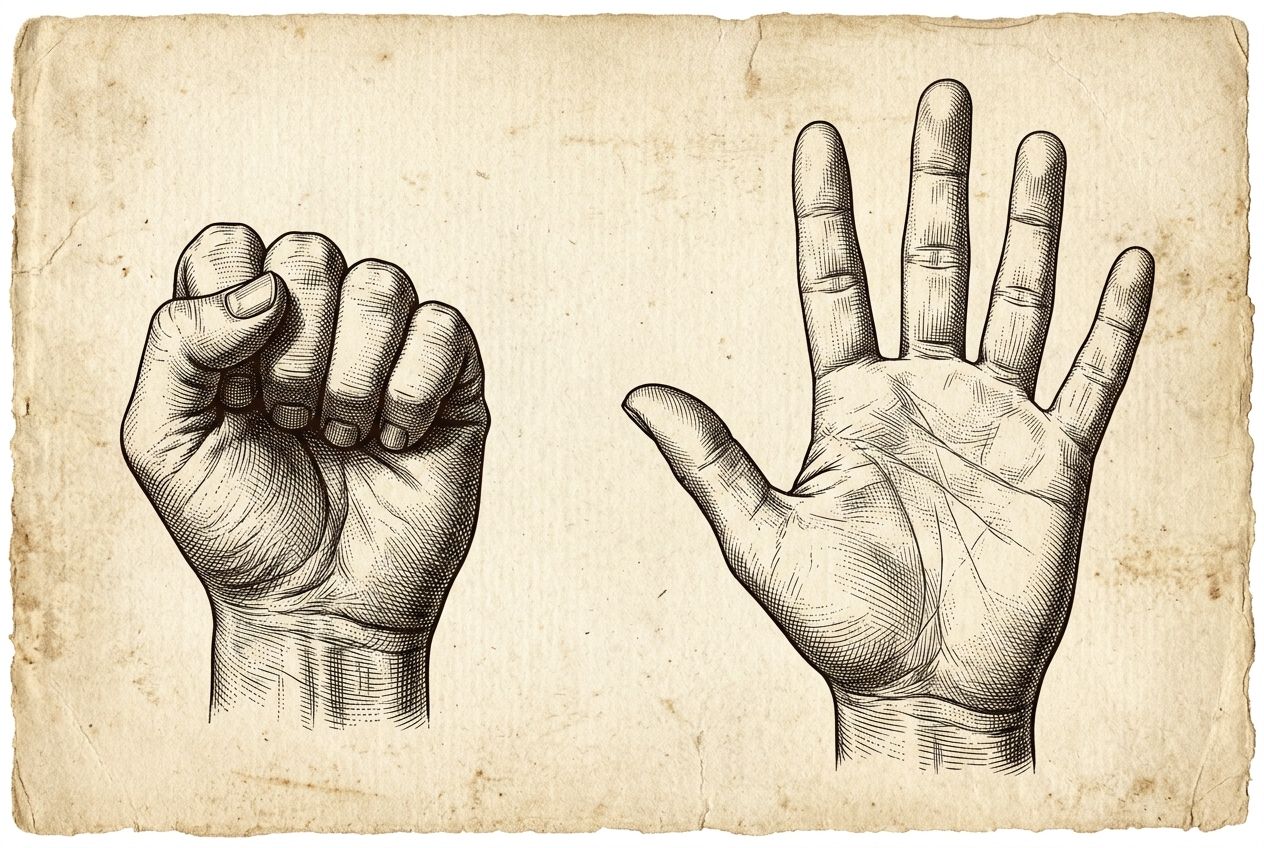
Hence Zeno of Citium too, asked in what dialectic differs from rhetoric, clenched his hand and opened it out again and said “in this” — by the clenching assigning to dialectic its compact and concise character, and by the opening and extension of the fingers hinting at the breadth of rhetorical power.
MODERN VISUALIZATION · TEXTUALLY ATTESTED
Fist and open palm: dialectic and rhetoric — a reconstruction
Modern drawing made for StoicOs — no ancient image survives. Following Sextus' report in this fragment: the clenched fist stands for dialectic, compact and concentrated; the open palm for rhetoric, broad and expansive. This is a different gesture from the four-stage sequence of SVF I.66.
- Dating
- Reconstruction: 2026; textual source: Sextus Empiricus, 2nd century CE
- Relation to Zeno
- Directly based on the gesture Sextus attributes to Zeno in this very fragment (SVF I.75 = Adversus mathematicos 2.7).
- Identification
- The gesture is textually attested; the drawing itself is a modern interpretation and has no ancient pictorial source.
- Source
- Sextus Empiricus, Adversus mathematicos 2.7 (SVF I.75)
- Image rights
- © StoicOs.ai — modern illustration, explicitly a reconstruction
Context
Sextus Empiricus tells the anecdote while discussing the arts of speech. The image was famous: Cicero uses it twice (De finibus 2.17; Orator 32,113 — “Zeno used to demonstrate with his hand”) and Quintilian repeats it. It is Zeno's second great hand-simile beside the katalēpsis gesture (SVF I.66) — same teacher, same method, different lesson.
Source notes:Greek text verified against H. von Arnim, SVF I (1903), no. 75, p. 21 (scanned page). The word „τούτω“ stands in quotation marks in von Arnim's print — it is the only word attributed to Zeno directly. The same image is multiply attested in Latin under the same number: Cicero, fin. 2.17 and Orator 32,113; Quintilian, Inst. 2.20,7 (printed by von Arnim in italic small type).
What the source actually tells us
Strictly speaking, only the gesture and the single word „τούτω“ (“in this”) are attributed to Zeno; everything after the raised dot is Sextus' own later interpretation of what the gesture meant — the two layers must not be merged. The anecdote itself is multiply attested (Sextus in Greek, Cicero twice and Quintilian in Latin), which secures the image, though the wording varies by reporter.
Philosophical meaning
Dialectic is the closed fist: tight, compressed, argument packed edge to edge. Rhetoric is the open palm: the same hand, the same reason, spread wide to reach an audience. Zeno's wordless answer teaches that the two arts of logos differ not in substance but in form — and that a true philosopher masters both grips.
Scholarly uncertainty
The interpretive clause is Sextus'; whether Zeno himself ever spelled out the comparison in words is unknown. The Latin reporters tell the story with different emphases (Cicero's Orator reverses the demonstration order), a normal sign of an anecdote transmitted orally before being written down.
Go deeper
About this edition
StoicOs Ancient Library is a developing multilingual digital study edition of surviving early Stoic material. The Stoicorum Veterum Fragmenta assembled by Hans von Arnim provides the traditional reference framework. StoicOs distinguishes carefully between fragments, testimonia, later reports and interpretation. StoicOs translations are prepared from the surviving ancient-language sources where available.