SVF I.66
- Estoico
- Zenón de Citio
- Fuente antigua
- Cicero, Academica Priora (Lucullus), Book II — Acad. pr. 2.144
- Lengua de la fuente
- Latín
- Estatus de la fuente
- Informe posterior
Original — Latín
Et hoc quidem Zeno gestu conficiebat. Nam cum extensis digitis adversam manum ostenderat, „visum“ inquiebat „huiusmodi est“. Deinde cum paullum digitos contraxerat, „adsensus huiusmodi“. Tum cum plane compresserat pugnumque fecerat, comprehensionem illam esse dicebat: qua ex similitudine etiam nomen ei rei, quod antea non fuerat, κατάληψιν imposuit. Cum autem laevam manum admoverat et illum pugnum arte vehementerque compresserat, scientiam talem esse dicebat, cuius compotem nisi sapientem esse neminem.Traducción StoicOs
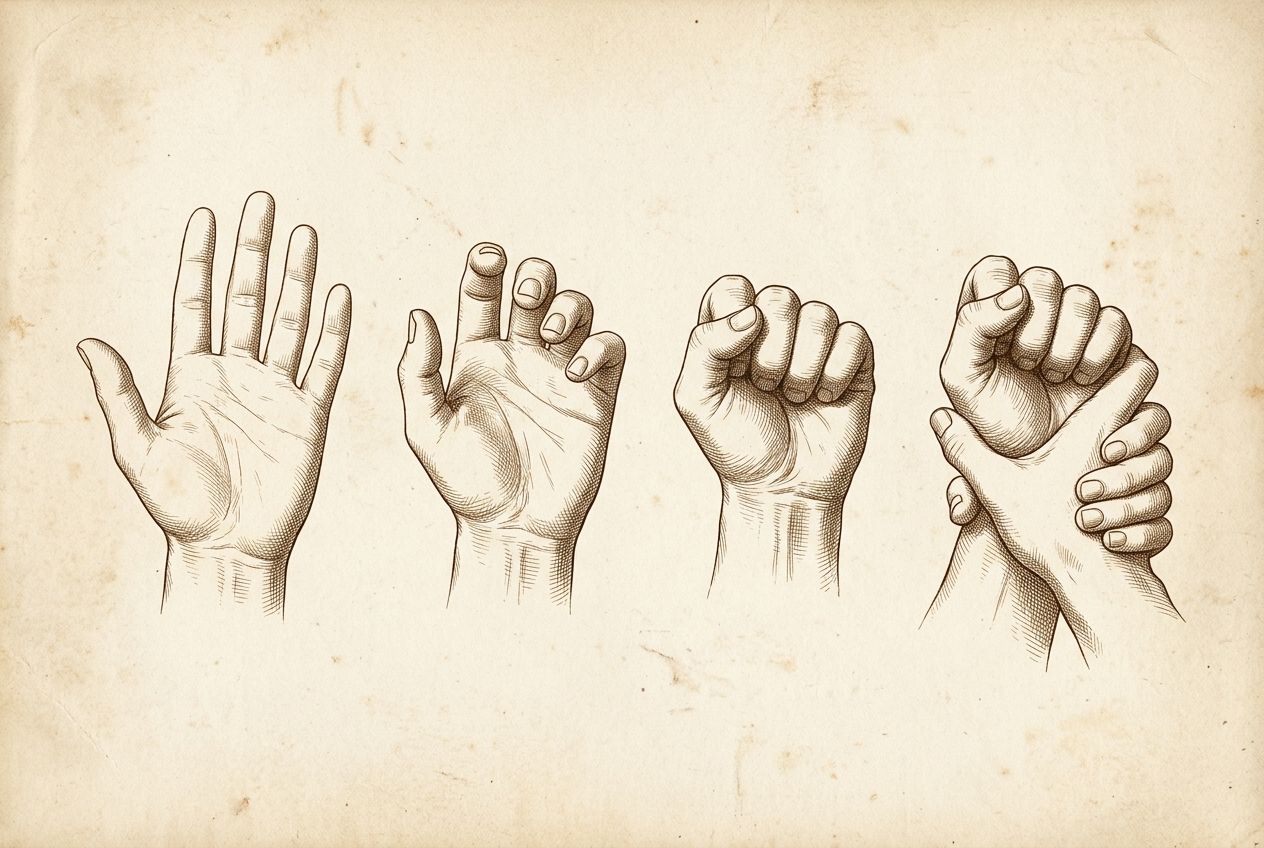
Y esto Zenón lo mostraba con un gesto. Cuando enseñaba la mano abierta, con los dedos extendidos, decía: “Así es una impresión.” Luego, con los dedos algo contraídos: “Así es el asentimiento.” Cuando los cerraba del todo y formaba un puño, decía que eso era la comprensión — y por esta comparación dio a la cosa un nombre que antes no tenía: katalēpsis. Pero cuando acercaba la mano izquierda y apretaba aquel puño con fuerza, decía que así era la ciencia — y que nadie la posee sino el sabio.
VISUALIZACIÓN MODERNA · ATESTIGUADA TEXTUALMENTE
Los cuatro gestos de la mano de Zenón — una reconstrucción
Dibujo moderno realizado para StoicOs — no se conserva ninguna imagen antigua de esto. De izquierda a derecha, según la descripción de Cicerón en este fragmento: la palma abierta (la impresión), los dedos ligeramente curvados (el asentimiento), el puño cerrado (la aprehensión cognitiva, katalēpsis) y el puño abarcado por la otra mano (el conocimiento, epistēmē).
- Datación
- Reconstrucción: 2026; fuente textual: Cicerón, 45 a.C.
- Relación con Zenón
- Basada directamente en la secuencia de gestos que Cicerón atribuye a Zenón en este mismo fragmento (SVF I.66 = Academica priora 2.144–145).
- Identificación
- Los gestos están atestiguados textualmente; el dibujo en sí es una interpretación moderna y carece de fuente pictórica antigua.
- Fuente
- Cicerón, Academica priora 2.144–145 (SVF I.66)
- Derechos de imagen
- © StoicOs.ai — modern illustration, explicitly a reconstruction
Contexto
Cicerón, escribiendo unos 250 años después de Zenón, relata esta famosa escena en el Lucullus durante el debate sobre si es posible el conocimiento cierto. El relato es latino e indirecto, pero conserva un vívido gesto docente y la afirmación de que Zenón acuñó el término katalēpsis.
Notas sobre la fuente:Texto verificado contra H. von Arnim, SVF I (1903), n.º 66, pp. 19–20 (páginas escaneadas). El aparato de von Arnim registra la variante contraxerat (cod. Cantabr.) frente a contexerat/conxerat. La palabra griega κατάληψιν está incrustada en el latín de Cicerón.
Lo que la fuente realmente nos dice
Es un informe posterior de la práctica docente de Zenón, no sus propias palabras: las frases citadas son la dramatización latina de Cicerón. Lo que el testimonio asegura es la escala de cuatro grados — impresión, asentimiento, comprensión, ciencia — y la acuñación de katalēpsis por Zenón; la redacción exacta de sus lecciones griegas no puede recuperarse de aquí.
Significado filosófico
La mano abierta, los dedos que se curvan, el puño, la mano izquierda que aprieta: ninguna imagen antigua explica mejor la epistemología estoica. Conocer aparece como un acto progresivo de la mente — recibir, asentir, asir, sujetar — quedando la ciencia plena reservada al sabio.
Profundiza más
Acerca de esta edición
La StoicOs Ancient Library es una edición de estudio digital multilingüe, en desarrollo, del material estoico temprano conservado. Los Stoicorum Veterum Fragmenta reunidos por Hans von Arnim proporcionan el marco de referencia tradicional. StoicOs distingue cuidadosamente entre fragmentos, testimonios, informes posteriores e interpretación. Las traducciones StoicOs se preparan, cuando es posible, a partir de las fuentes conservadas en lengua antigua.