Stoic Concept · StoicOs Card 007
Memento Mori — Remember You Must Die
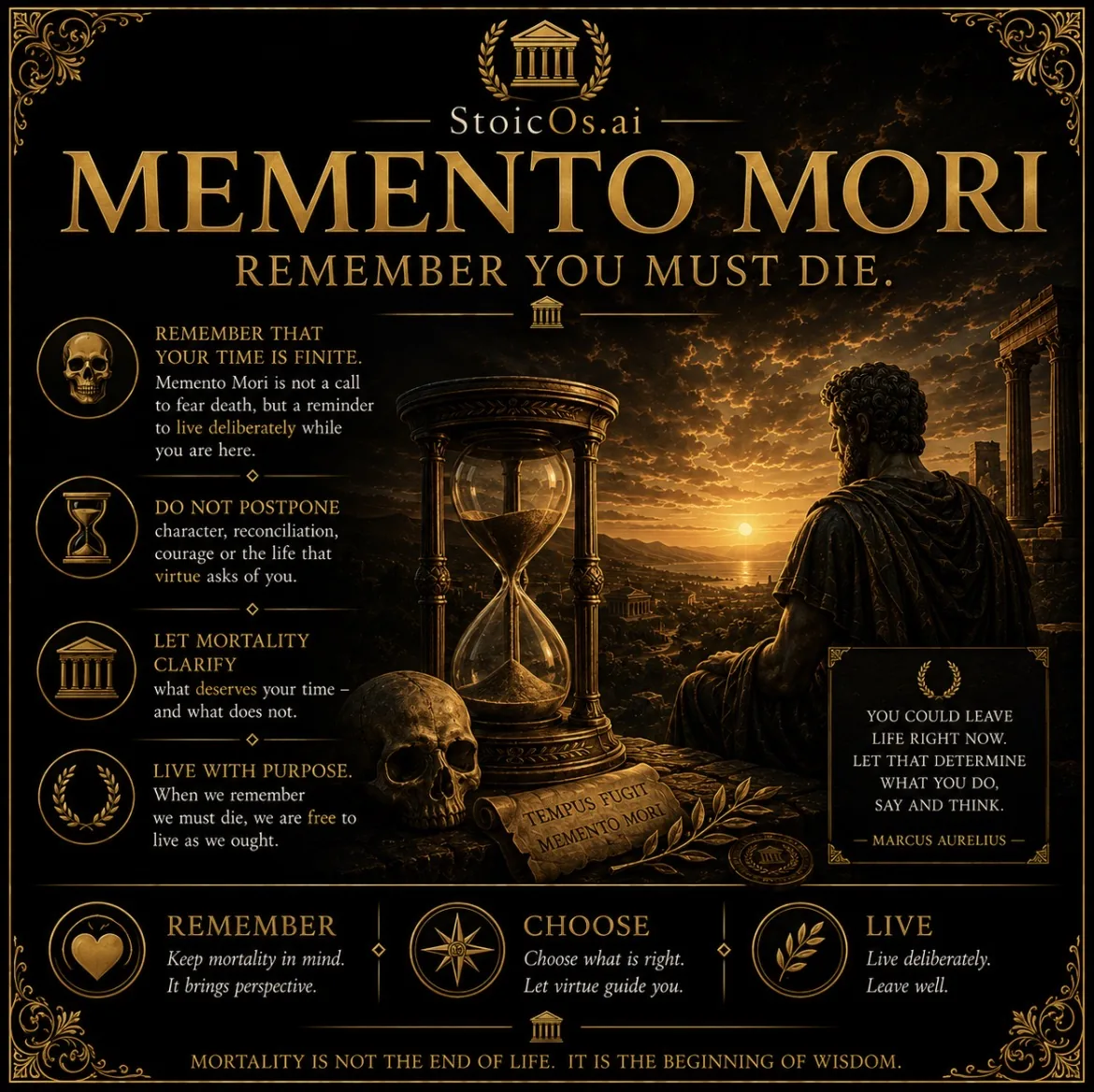
Memento mori is Latin for “remember you must die”. In Stoic practice it is not morbid: keeping mortality honestly in view clarifies what deserves your time, dissolves postponement, and frees you to live deliberately. As Marcus Aurelius wrote to himself: “You could leave life right now. Let that determine what you do and say and think” (Meditations 2.11, trans. Gregory Hays).
Definition
Memento mori names a family of Stoic exercises that use the fact of death as an instrument of clarity. Seneca argued that we do not receive a short life but make it short by wasting it (De Brevitate Vitae 1), and advised rehearsing the thought of loss in advance. Epictetus told students to keep mortality — their own and their loved ones' — before their eyes daily (Enchiridion 21), not to darken life but to remove the false assumption of unlimited time.
Historical context
The theme is everywhere in the Stoa: Marcus reminds himself that he could depart at any moment (Meditations 2.11), that all things pass quickly into oblivion (4.6), and that death is a natural operation of nature (2.17). Seneca's letters open with the accounting of time (Letters 1). The famous whisper to Roman triumphators — a slave repeating that the general was mortal — is later legend, but the philosophical practice is authentically ancient.
What it means
- Your time is finite — so what you do with today is a real, not theoretical, choice.
- Do not postpone character: reconciliation, honesty, courage and the life virtue asks of you are due now.
- Let mortality rank your commitments: much that feels urgent does not survive the question “would this matter if this year were my last?”
What it does not mean
- Not a fascination with death or an invitation to gloom — the exercise serves life, not fear.
- Not an excuse for recklessness (“you only live once”): the Stoic conclusion is deliberateness, not indulgence.
- Not a denial of grief: Stoics prepare for loss to meet it with steadiness, not to feel nothing.
Modern examples
- — A postponed conversation with a parent happens this week, not “some day”.
- — An evening reclaimed from doom-scrolling because the hour was seen, for once, as spent rather than passed.
Practice: The evening measure (3 minutes, nightly)
- At day's end, ask: “If this had been my last ordinary day, was it spent on what I claim matters?”
- Name one thing you postponed that mortality would not postpone.
- Schedule it — concretely — for tomorrow.
In the StoicOs practice path
In the StoicOs curriculum memento mori lives in Stoic Physics (change, loss and impermanence): seeing your own life as a finite part of nature's constant transformation. It powers the Journal's evening reflection and gives the virtue test its urgency.
Go deeper
Frequently asked
Isn't thinking about death unhealthy?
Occasional, structured reflection on mortality — the Stoic form — is the opposite of rumination: it is brief, purposeful and ends in a concrete choice about today. The Stoics used it to cure procrastination and pettiness, not to induce anxiety. If it produces dread rather than clarity, shorten the exercise and anchor it to gratitude for the day you have.
Sources
- Marcus Aurelius, Meditations 2.11 (trans. Gregory Hays); 2.17; 4.6
- Seneca, De Brevitate Vitae 1; Letters to Lucilius 1
- Epictetus, Enchiridion 21